
REVIEW · CUSCO REGION, PERU
Cusco: 3-Hour Peruvian Cooking Class
Peru tastes best at the cutting board. This three-hour Cusco cooking class begins at the Peruvian Central Market, then moves to ChocoMuseo beside Plaza Regocijo for a practical lesson and shared meal. I like the market visit because it gives you a look at the produce behind Peruvian cooking, not just a recipe card. I also like that the small group is limited to 10 people, so there is room for questions and hands-on work.
The menu covers ceviche, a main dish, a pisco sour, and chocolate fondue with local fruit. Instructors such as Miguel and Yil add food and cultural background as they work, which makes the class feel more personal than a simple demonstration. The main drawback is that you do not freely choose between the two meat dishes: the first person booked decides between lomo saltado and ají de gallina, so you should state your preference early.
Key points to know before booking
- The class starts with a real market visit: You explore local ingredients and Peruvian fruits before cooking.
- The menu has four distinct parts: Ceviche, one main course, a pisco sour, and chocolate fondue with fruit.
- The first booking chooses the main dish: The group cooks either lomo saltado or ají de gallina.
- Miguel and Yil have received especially warm praise: Their clear instruction, cultural stories, and friendly manner add real value.
- The class stays small: With no more than 10 participants, you get a better chance to handle ingredients and ask questions.
- Allow three hours and book at least 24 hours ahead: The kitchen needs time to prepare the ingredients and supplies.
Starting at the Central Market in Cusco
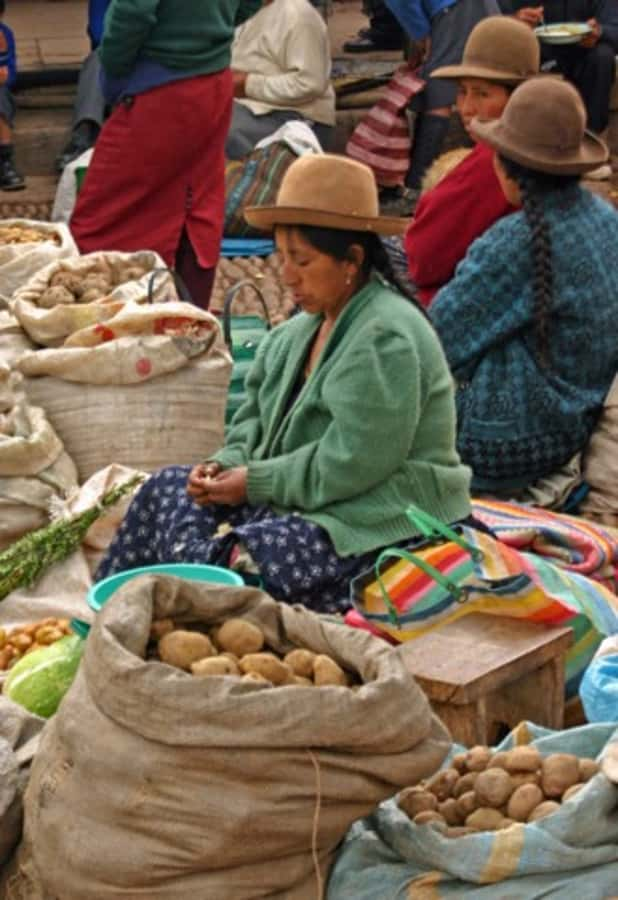
The market visit gives the class its local footing. Rather than beginning with pre-measured ingredients in a classroom, you first see the range of produce used in Peruvian cooking. The focus includes vegetables, potatoes, herbs, fruit, and the ingredients needed for the evening menu.
This matters because Peruvian food is built around strong contrasts and a wide range of local products. A market visit helps you understand that ceviche is more than fish and lime, and that a dish such as ají de gallina depends on the character of its pepper sauce. You get a better sense of what is common in a Peruvian kitchen and what may be unfamiliar to you.
The instructor guides you through the shopping and explains the origins and uses of the ingredients. Miguel has been praised for giving useful background on both food and culture, while Yil has been noted for sharing facts about Cusco’s history and ingredients. The value here is not just identification. You learn why the items matter before you start chopping them.
You may also try Peruvian fruits during this part of the class. That small tasting is worth paying attention to, since the same local produce later appears in the dessert and gives the meal a clear connection between market and table.
The market is not a sightseeing stop with a long list of landmarks. It is a working food market, and the attraction is the produce and the explanation. If you prefer quiet, polished surroundings from the first minute, the market may feel less comfortable. If you want food context that reaches beyond a restaurant menu, it is one of the best parts of the afternoon or evening.
More Three-Hour Classes in Peru:
- Marrakech: 3-Hour Open-Air Moroccan Cooking Course
★ 4.9 · 74 reviews - 3-Hour Cooking Class overlooking the Blue City
★ 5.0 · 36 reviews - 3-hour Tuscan Cooking Class with Wine & Oil Tasting
★ 4.5 · 36 reviews
Finding ChocoMuseo beside Plaza Regocijo
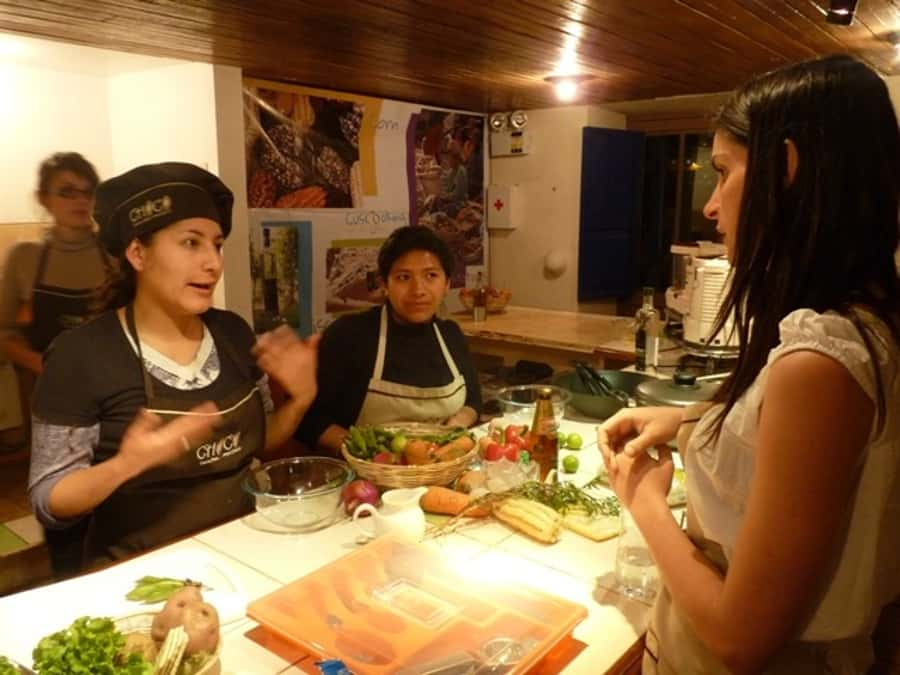
After the market, the lesson takes place inside ChocoMuseo, on the corner of Plaza Regocijo. Look for the green and orange flags hanging from the balconies. This meeting point is useful because it gives you a clear visual marker in a central Cusco location.
The cooking space is described as friendly and relaxed, rather than formal. That tone suits the class. You are expected to work, taste, and share the finished food, so an overly serious kitchen would miss the point. The group limit of 10 helps keep the setting manageable, although the exact amount of individual cooking time can depend on the group.
Instruction is available in English and Spanish. This is important for a class built around technique. You need to understand timing, knife work, seasoning, and the order in which ingredients are prepared. The warm feedback for Miguel and Yil suggests that the teaching style is a major part of the experience, not an afterthought.
You should tell the operator your preferred main dish when booking. The first person booked makes the final choice for the group, so your preference is not guaranteed unless you are the first booking. That is a minor planning point, but it can make a difference if you strongly prefer beef over chicken or need to avoid one option.
Preparing ceviche as the opening course
Ceviche begins the meal and gives the class a chance to focus on one of Peru’s best-known dishes. The lesson covers the ingredients supplied for the recipe and the steps needed to prepare it under instruction.
The appeal of making ceviche in class is that you can pay attention to balance. The acidity, seasoning, fish, and other ingredients need to work together. You are not simply served a finished bowl and told that it is a national classic. You see how the components are brought together and then taste the result at the table.
The exact type of fish and full recipe are not specified, so you should not expect a fixed set of ingredients beyond the advertised dish. The instructor’s guidance is the useful part. You can ask about preparation and then take the basic method home.
This is also where the market visit pays off. Ingredients you have just seen in their raw form now become part of a familiar Peruvian dish. That connection gives the class more meaning than a stand-alone cooking lesson.
Choosing between lomo saltado and ají de gallina
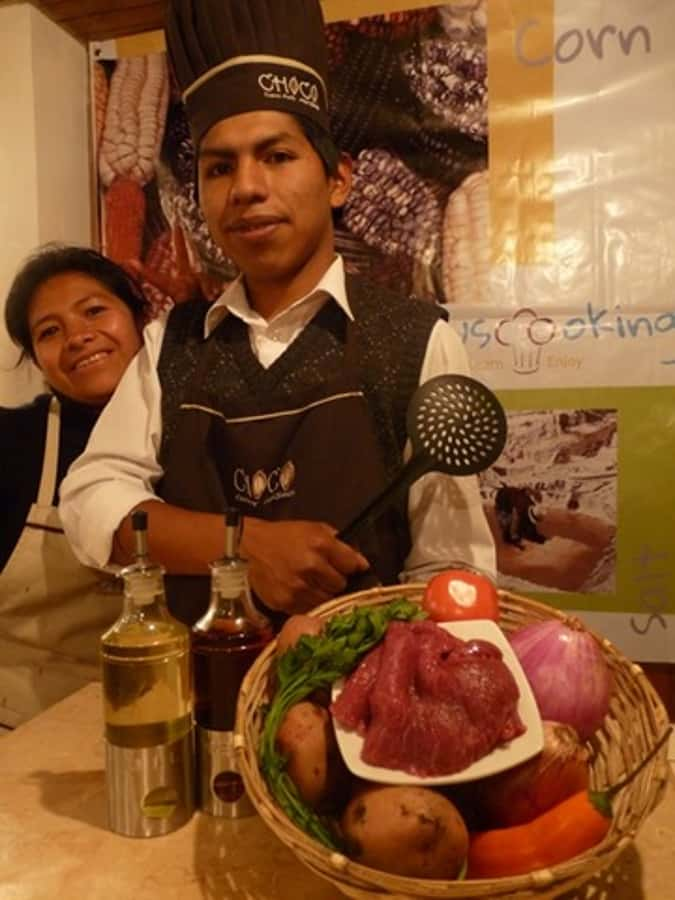
The main course is either lomo saltado or ají de gallina. The choice is made by the first participant booked, so the whole group prepares the same dish.
Lomo saltado is a sautéed beef dish, and the class presents it as an example of Peru’s lively, fast-cooked style. Ají de gallina is chicken in a yellow pepper sauce, offering a softer, saucier alternative. Both give you a useful look at different sides of Peruvian home cooking.
The first booking rule is the clearest limitation of the class. You cannot count on cooking your preferred dish unless you arrange the booking early enough to make the decision. Ask about the chosen menu before you attend if the distinction matters to you.
Vegetarian options are available upon request, and the meat course can be replaced. Make that request ahead of time rather than waiting until the class begins. The information provided does not specify the exact vegetarian substitute, so you should confirm what will be prepared before booking if you have strict dietary needs.
Instruction covers preparation and plating, not just the final taste. One participant particularly valued learning knife skills, while others enjoyed being guided step by step through ingredient selection, cooking, and presentation. That makes the class useful even if you already enjoy cooking, since you leave with techniques as well as a meal.
One practical issue deserves attention. A comment about the rice and potatoes being cold in the main course points to a possible timing problem when those items are prepared too early. This does not cancel out the quality of the class, but it is a fair reminder that a small group kitchen may not deliver every component at the same instant. If freshness and serving temperature matter greatly to you, ask the instructor how the side dishes will be timed.
A few more cooking classes around Peru worth a look
- Cusco: Peruvian Cooking Class, Cocktails & Local Market Tour
★ 4.9 · 512 reviews - Cooking class and market tour with a local chef
★ 5.0 · 186 reviews - Market Tour, Tasting of 35 Fruits, and 4-Course Peruvian Cooking Class in Lima
★ 5.0 · 86 reviews - #1 Rated Cooking Classes with Local Market Tour & Pickup
★ 5.0 · 69 reviews
Mixing a pisco sour, or choosing fresh juice
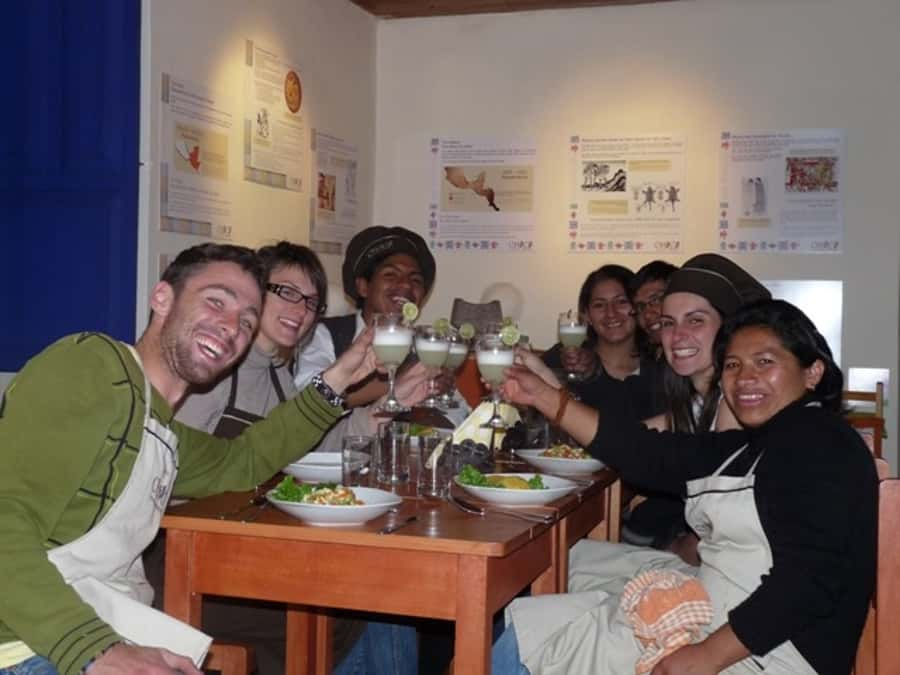
The pisco sour is part lesson and part reward. You learn how to prepare Peru’s famous cocktail, then serve it with the meal. The class includes one pisco sour, and water is also provided.
This is a good feature for first-time visitors because it connects a national drink to the food you are making. You do not need to find a bar later and guess what belongs in the glass. You learn the basic preparation during the class and can try it again at home.
A chicha pisco sour was singled out as especially enjoyable, so the drink may include a local variation depending on the lesson. The exact cocktail style is not guaranteed, but the class does focus on preparation rather than simply handing you a drink.
If you do not want alcohol, a fresh fruit juice can be requested instead. Other alcoholic drinks are not included. Wine is available for purchase, but you should not assume that additional drinks come with the $49 price.
Ending with chocolate fondue and local fruit
Dessert is chocolate fondue with local fruits. It is a simple finish, but it works well after the savory dishes and returns you to the ingredients first introduced at the market.
The fruit gives you another chance to taste Peru beyond familiar restaurant staples. Since the class includes a market visit and fruit tasting, dessert feels connected to the wider food lesson rather than added as a generic sweet course.
The meal is served after the preparation is finished, in a relaxed setting. You get time to sit down and eat what you made, which is essential to the value of a cooking class. A demonstration without a shared meal would be cheaper and shorter, but it would also leave out the most satisfying part.
The class description calls the food a four-course meal, while the included details describe a three-course meal with a pisco sour. In practical terms, expect a four-part menu: starter, main, cocktail, and dessert. The pisco sour is a drink course rather than a plate of food, which explains the different wording.
What $49 buys you in Cusco
At $49 per person, the price is reasonable if you want more than dinner. You are paying for the market tour, ingredients, cooking instruction, kitchen equipment, water, and the meal you prepare. The small group size also matters because you are not paying for a large lecture with little chance to participate.
A restaurant meal could cost less, especially if you choose a modest local place. It would not give you the market context, cooking practice, or recipe knowledge. On the other hand, someone who wants a long professional culinary workshop may find three hours too short.
I see the strongest value in the combination of market and kitchen. Each part supports the other. You identify the ingredients, learn how they are used, prepare them with help, and eat the result. That is a fuller introduction to Peruvian food than ordering several dishes without explanation.
The class also works well early in a Cusco stay. You can learn about local ingredients at the beginning of your visit and then notice them on restaurant menus or markets later. You may even want to recreate the pisco sour or the main dish at home.
Timing, group size, and practical details
The class lasts three hours, with starting times based on availability. It is long enough for a market visit, cooking, and a shared meal without taking up an entire day.
A maximum of 10 participants is a useful limit. You should have a better chance to handle ingredients and receive direct help than in a large group. Still, the experience is shared, so you will not control every step or choose every dish independently.
Book at least 24 hours ahead. The kitchen needs time to arrange the ingredients and supplies, and the class may be cancelled if there is not enough notice. This is particularly important if you are visiting Cusco for only a short time.
Cancellation is free up to 24 hours before the activity for a full refund. You can also reserve and pay later, which helps if your schedule is not fixed. These policies are useful, but they do not remove the need to check your menu preference and dietary requests early.
The meeting point is ChocoMuseo at the corner of Plaza Regocijo. Use the green and orange balcony flags to find it. The activity is in the Cusco Region, and no hotel transport is included in the information provided, so plan to reach the meeting point yourself.
Who will enjoy this class most?
I would recommend it to anyone who wants a hands-on introduction to Peruvian food rather than another sightseeing walk. It is especially suited to couples, friends, solo participants, and small family groups who enjoy eating together and do not mind sharing the kitchen.
It also suits curious cooks. The knife skills, ingredient explanations, menu preparation, and plating give you several useful takeaways. You do not need advanced cooking ability, since the class is guided step by step.
The class may be less suitable if you need complete control over the menu. The first booking chooses the main dish, and the exact vegetarian alternative must be requested in advance. It may also disappoint anyone looking for a private class, since the activity is a small group rather than a one-party lesson.
Keep the temperature note about rice and potatoes in mind. Most of the class feedback is strongly positive, but that detail shows the meal may not be perfectly timed in every session. I would still consider it a minor issue within a three-hour practical class, not a reason to dismiss the activity.
Should you book the Cusco cooking class?
Book it if you want a friendly, useful taste of Peruvian food culture and like the idea of making your own dinner. The central market, the small group, the pisco sour lesson, and the chance to cook with instructors such as Miguel or Yil make this more worthwhile than a basic meal.
Check the main dish before you commit, and send vegetarian or nonalcoholic requests at least 24 hours ahead. If you accept a shared class and a menu chosen by the first booking, the $49 fee gives you a solid three-hour introduction to Cusco’s food traditions.
FAQ
Where does the cooking class meet?
The class takes place inside ChocoMuseo on the corner of Plaza Regocijo. Look for the green and orange flags hanging from the balconies.
How long does the activity last?
The cooking class lasts three hours.
What language is the instruction offered in?
Instruction is available in English and Spanish.
How many people can join the group?
The group is limited to 10 participants.
Does the activity include a market visit?
Yes. The experience includes a guided tour of the Peruvian Central Market.
What food will I prepare?
The menu includes ceviche, either lomo saltado or ají de gallina, and chocolate fondue with local fruits.
Who chooses between lomo saltado and ají de gallina?
The first participant booked chooses the main dish for the group. You should state your preference when booking.
Can I request a vegetarian main dish?
Yes. The meat course can be replaced with a vegetarian option upon request.
Can I replace the pisco sour?
Yes. Upon request, the pisco sour may be replaced with fresh fruit juice.
What is included in the price?
The price includes the guided market tour, cooking ingredients, instruction, dinner, one pisco sour, water, and cooking supplies. Wine and other alcoholic drinks are not included, and gratuity is extra.
Just added around Peru
- Lima: Peruvian cooking class and tour of Surquillo market★ 5.0 · 2 reviews
- Lima: Market Tour and Cooking Class with Pisco Sour★ 5.0 · 3 reviews
- Lima: Cooking Workshop and Water Circuit Tour★ 5.0 · 16 reviews
- Lima: Market Tour, 35 Fruits Tasting & Cooking Class★ 5.0 · 3 reviews
- Lima: 4-Course Peruvian Cooking Class in Miraflores★ 5.0 · 4 reviews
- Lima : Cooking Class – A Peruvian Culinary exploration★ 5.0 · 2 reviews
- Lima: Demo Cooking Class with Lunch at Cala Restaurant★ 4.1 · 4 reviews
- Cusco: Peruvian Cooking Class★ 5.0 · 2 reviews
Cooking Classes, compared.

Half-Day Thai Cooking Class at Organic Farm in Chiang Mai
Read our review →

3 in 1 Cooking Class near Navona: Fettuccine, Ravioli & Tiramisu
Read our review →
Pasta & Tiramisu Cooking Class with Unlimited Wine
Read our review →
Hanoi Cooking Class: Culture, Local Market & Meaning CSR Impact
Read our review →
5 Traditional Dishes Hanoi Cooking Class with Market Trip
Read our review →
Cooking Class and Lunch at a Tuscan Farmhouse with Local Market Tour from Florence
Read our review →
Cooking Class, Market & Thai Herbs Garden Tour
Read our review →Lists this class appears in