REVIEW · BALI, INDONESIA
Pure Bali Village Experience Cooking & Jamu Class, Transfer
Step off the resort path for a day. This full-day outing near Mount Batukaru combines rice terraces, village life, Balinese cooking, jamu making, a small farm, and a mountain hot spring for $61 per person. I especially like the hands-on cooking class and the chance to see working agriculture rather than a staged cultural show.
The rice terrace walk and local market stop add real daily life to the day, while the jamu lesson gives you a taste of Indonesia’s traditional herbal drinks. The main consideration is physical: the route includes a soft downhill walk of about 30 minutes, uneven village ground, and no wheelchair access.
The program is full, so you should expect a long day. That is part of its value, but it also means this is not the right pick if you want a slow morning or a short cooking lesson with little walking.
Key Details Before You Book
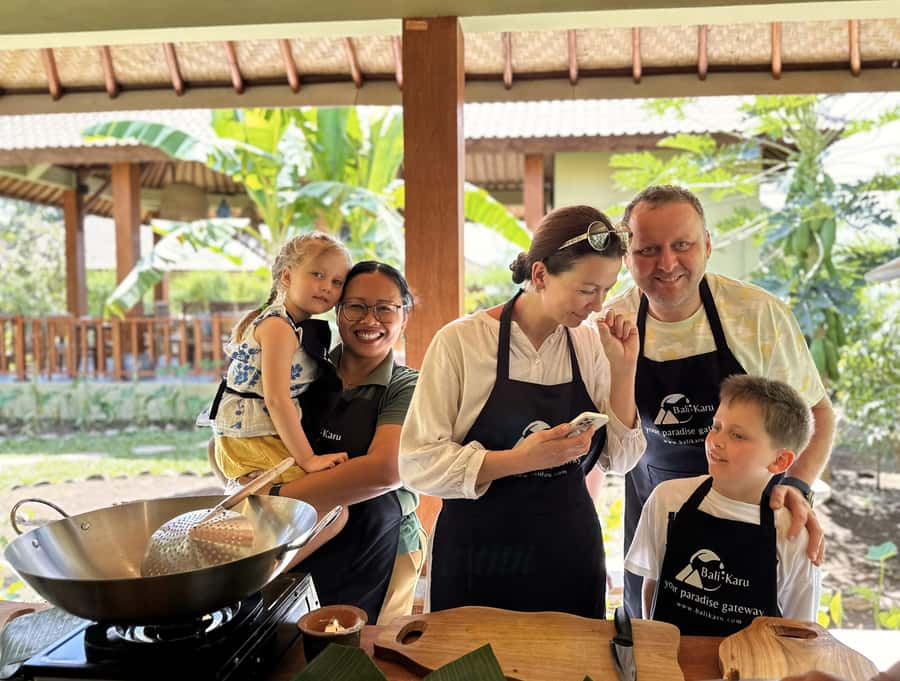
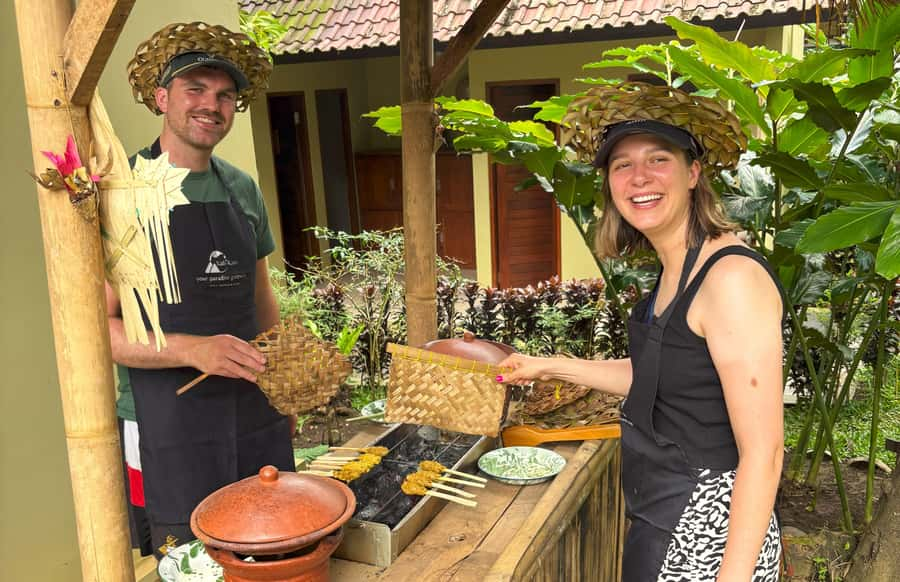
- You cook a complete Balinese meal: Make spice paste, sambal, steamed chicken, satay, vegetables, tempeh, and dessert, then eat what you prepared.
- Jamu is made from scratch: Prepare two herbal drinks, including beras kencur and turmeric, ginger, and tamarind jamu.
- The setting is rural and practical: Walk through rice terraces, visit a farm, help with rice planting, and see stingless Trigona bee hives.
- The day includes traditional music: Try the Rindik, a bamboo instrument used in Balinese music.
- The route ends at Belulang Hot Spring: Bathing is optional, and your driver meets you there for the return trip.
- Pickup covers a broad area: Transfers are offered from hotels within 50 kilometers east and south of Belulang village, including Ubud, Sanur, Canggu, Kuta, Seminyak, Nusa Dua, Jimbaran, Candi Dasa, and other listed areas.
The Drive Toward Mount Batukaru
Your day begins with hotel pickup in an air-conditioned vehicle. The covered pickup area is unusually broad, which makes this outing practical for people staying in Ubud, the southern beach districts, or Candi Dasa. You must provide your exact hotel location when booking. If you do not, you may be asked to reach the activity starting point yourself.
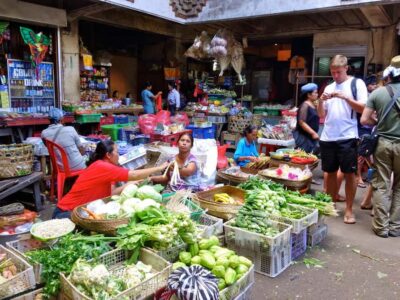
The drive is part of the transition from coastal Bali to the cooler mountain countryside. You can request photo stops along the way, and a flower market stop is included. Timing matters here. One early morning visit found the flower market closed, so the group went instead to a small local market selling fruit, food, and everyday goods.
That replacement can be just as useful. A local market gives you a look at ordinary shopping without the polished presentation of a tourist attraction. Still, you should treat the flower market as a planned stop rather than a guarantee of a busy market scene at every hour.
The road time also depends on your hotel. Pickup from Ubud is not the same as pickup from Kuta or Nusa Dua. Ask for the expected pickup time when you confirm, especially if you are staying far from the village.
More Farm Cooking Classes in Indonesia
- Ubud: Balinese Cooking Class at an Organic Farm
★ 5.0 · 1,786 reviews - From Ubud: Authentic Cooking Class in a Local Village
★ 4.9 · 1,325 reviews - Balinese Farm Cooking Class by Pemulan Bali
★ 5.0 · 410 reviews
Rice Terraces and Working Village Life
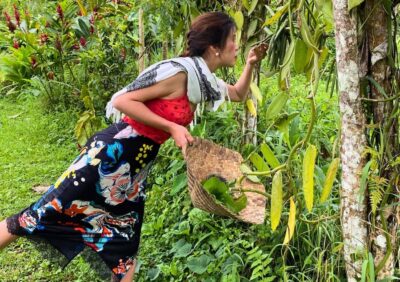
Near the mountain village, you begin with a walk beside rice terraces. This is not just a viewpoint stop. Your guide points out tropical plants, herbs, and fruit, and you may see farmers working the fields. If conditions are right, a farmer may be ploughing with a water buffalo.
That detail matters because it shows the link between the food on your plate and the work required to grow it. The walk also gives you a better sense of how villages function around the rice cycle. You are seeing paths, fields, homes, and farms as part of one working place.
The route is scenic, but it is not fully accessible. Expect uneven surfaces and walking outdoors in a warm climate. Later, the route slopes downhill for around 30 minutes, so sturdy shoes are sensible. This is a poor fit for wheelchair users or anyone who has trouble walking on village paths.
Rindik Music and the Balikaru Garden
At Balikaru, you receive a welcome drink and try the Rindik, a traditional bamboo instrument. You do not need musical training. The point is to make a sound, learn how the instrument works, and understand that music is part of everyday Balinese culture, not only a performance arranged for visitors.
The herb and spice garden follows. Your guide introduces the plants behind familiar Balinese flavors and explains their use in traditional medicine. This is useful preparation for the cooking class because ingredients such as turmeric, ginger, and other aromatics become easier to recognize when you see the plant itself.
I like this part because it slows the pace before the kitchen work begins. You are not simply handed a bowl of prepared ingredients. You get some context for why Balinese food has such strong herbal and spice flavors.
The garden is also one of the more educational stops. If you enjoy botany, cooking, or natural remedies, you will get more from this section than someone interested only in eating lunch.
Making Two Balinese Jamu Drinks
Next comes jamu, Indonesia’s traditional herbal drink. You prepare two varieties using family recipes and traditional utensils, then taste what you make.
The examples include beras kencur, a rice and spice drink, and jamu kunyit jahe asam, made with turmeric, ginger, and tamarind. The flavors are likely to be sharper and more earthy than the sweet bottled drinks found in shops, which is exactly why the lesson is worthwhile.
Jamu is tied to daily life and traditional health practices. The class gives you a simple way to understand that connection without turning the subject into a lecture. You see the ingredients, take part in the preparation, and taste the result.
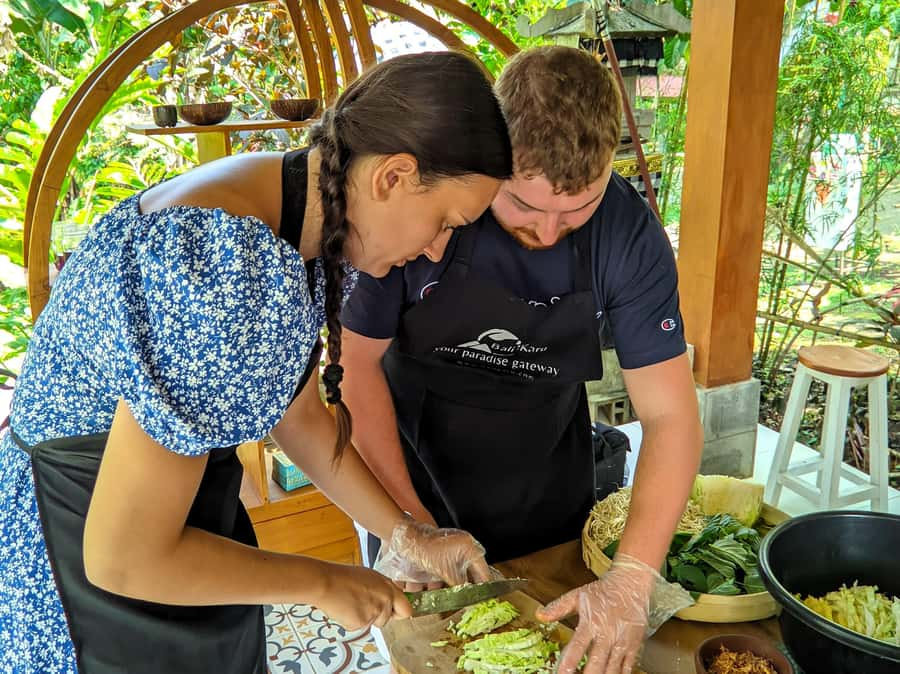
This section is also a good choice for people who do not cook much. The class has staff who can help with chopping and cooking tasks when needed, so you can participate at your own pace. That makes the program approachable for beginners, though the full day still involves plenty of activity.
More Balinese Cooking Classes in Indonesia:
- Ubud Cooking Class Bali with Balinese Chef
★ 5.0 · 1,609 reviews - PRIVATE Authentic Balinese Cooking Class in Ubud at Putu’s Home
★ 5.0 · 644 reviews - Balinese Ubud cooking school (9 Dish Cooking and Market Tour)
★ 5.0 · 540 reviews - Ubud: Balinese Cooking Class and Market Tour
★ 4.8 · 531 reviews
Paon Bali: A Hands-On Balinese Kitchen
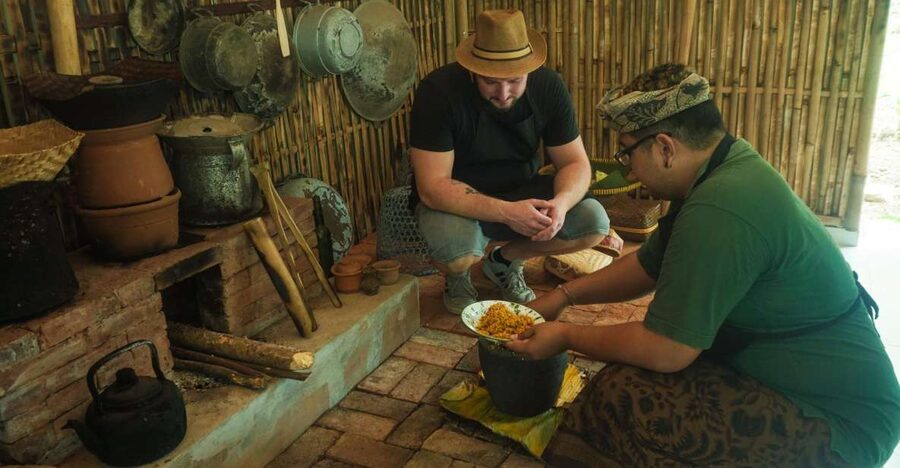
The open-air Paon Bali kitchen is the center of the day. Under the direction of a Balikaru chef, you prepare a substantial meal rather than one token dish.
The menu can include:
- Base genap, a Balinese spice paste
- Sambal mbe and sambal matah
- Tum ayam, chicken with herbs steamed in banana leaves
- Chicken sate lilit grilled at a traditional gerobak station
- Tempeh kecang with sweet soy sauce
- Sayur urap with vegetables, coconut, and herbs
- Sayur paku, a fern dish
- Lak lak or another traditional dessert
This is a generous menu for the price. You get several types of preparation: pounding and mixing spice paste, chopping, wrapping food in banana leaves, shaping minced chicken around satay sticks, and grilling at the gerobak station.
Sate lilit is especially interesting because the meat is seasoned and shaped rather than served as a simple cube on a skewer. Tum ayam shows another useful Balinese method, using banana leaves to hold moisture and aroma while the chicken steams.
A posted group size reached 11 people, so do not assume this is always a private lesson. That said, the kitchen is staffed well enough for beginners to take part without having to complete every technical step alone. If you are confident in the kitchen, you may wish for more individual control. If you are not, the support is a real advantage.
The meal is served as nasi campur tumping with dessert at the peaceful Warung Balikaru. Since you prepare the food yourself, lunch feels like the payoff to the morning rather than a separate restaurant stop.
Vegetarian requirements can be accommodated if you provide them when booking. People with food allergies should not book this activity, according to the stated restrictions. The menu includes chicken, soy, coconut, spices, and other ingredients, so do not rely on making changes at the last moment.
Farm Animals, Rice Planting, and Trigona Bees
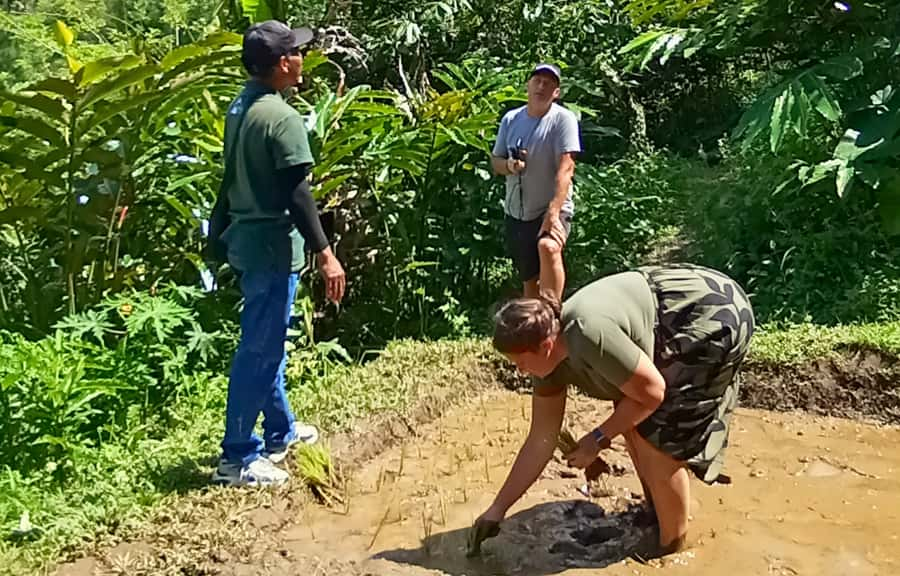
After lunch, the focus shifts back outdoors. You help a farmer plant rice, a small task that connects neatly with the morning terrace walk. It is not a full agricultural workday, but it gives you a feel for the care and labor behind one of Bali’s most important crops.
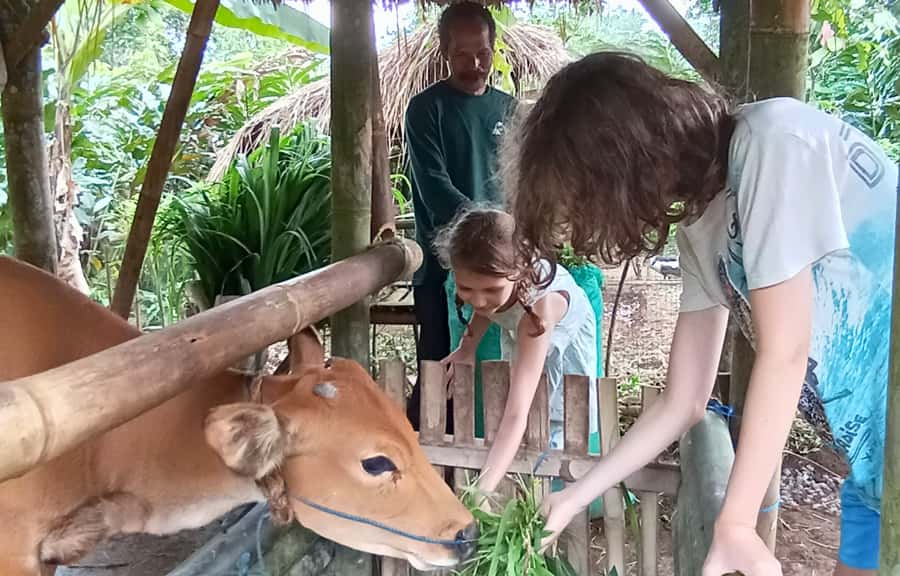
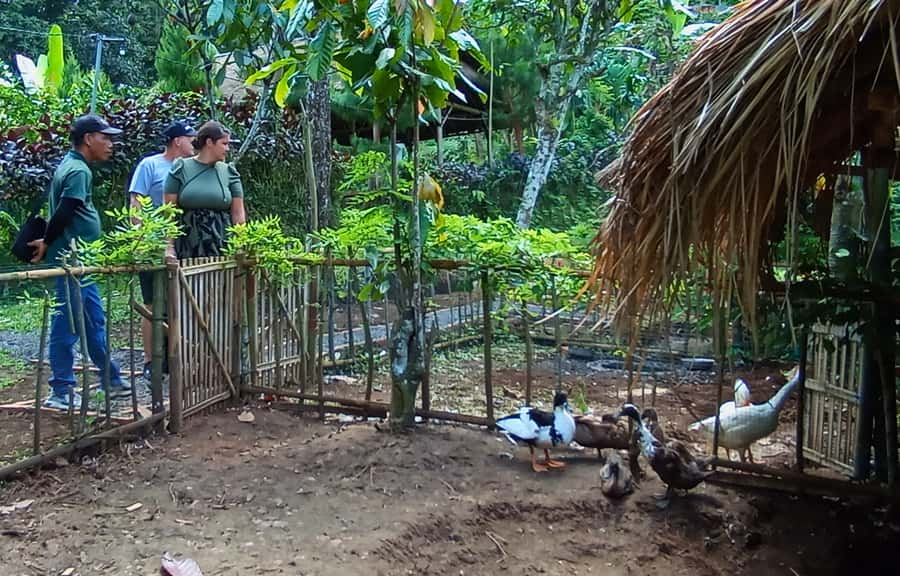
At the Balikaru farm, you meet ducks, geese, and a friendly cow named Manis. You can feed her, which adds a light, personal moment after the more structured cooking activities.
The Trigona bee hives are a particularly good addition. These stingless bees produce honey valued for its health benefits, and the visit introduces a form of beekeeping that many people have never seen. You do not need to be an insect enthusiast to appreciate the stop. It is brief, unusual, and tied to the farm’s wider food system.
The farm also keeps the day from becoming only a cooking demonstration. You see animals, crops, traditional work, and food preparation in the same setting.
A Downhill Village Walk to Belulang Hot Spring
The final walk leads downhill through the mountain village, with views toward the surrounding peaks. Along the way, you can see local homes, learn about Balinese compound design, and hear about traditional feng shui.
The walk is described as soft trekking, but the downhill direction still matters. If your knees or balance are an issue, ask about the route before booking. This is the point in the day when tiredness may catch up with you.
The walk ends at Belulang Hot Spring, where you can choose to bathe. The driver waits there to take you back to your hotel. Because the hot spring is optional, you can skip the bath if you prefer to change clothes, rest, or simply finish the day without another activity.
The closing photo with the Balikaru family, the small gift, and the cooking certificate give the day a clear ending. A recipe collection is also sent by email after the visit, which is more useful than a souvenir that sits on a shelf. You can try the dishes again at home while the methods are still fresh.
What the $61 Price Really Includes
At $61 per person, the value is strong if you plan to use most of the program. The price includes hotel transfers, an English-speaking guide, the market or flower stop, welcome drink, music activity, garden tour, jamu ingredients and tasting, cooking instruction, barbecue, lunch, farm visit, rice planting, village walk, hot spring visit, gift, and later recipe material.
You would pay separately for transport, a cooking class, lunch, and a countryside excursion if you arranged these pieces independently. The included air-conditioned transfer is especially useful from the southern resort districts, where reaching the mountain village without a car can be inconvenient.
The price does not include tips, drinks, or personal expenses. Languages listed include English, German, Italian, and French, though languages other than English may carry an extra charge.
The main cost is your time. This is a full-day program with a broad itinerary, not a quick half-day class. For someone who wants cooking plus rural culture, that is good value. For someone who wants only to learn two or three recipes, a shorter class may suit better.
Who Will Enjoy This Day Most
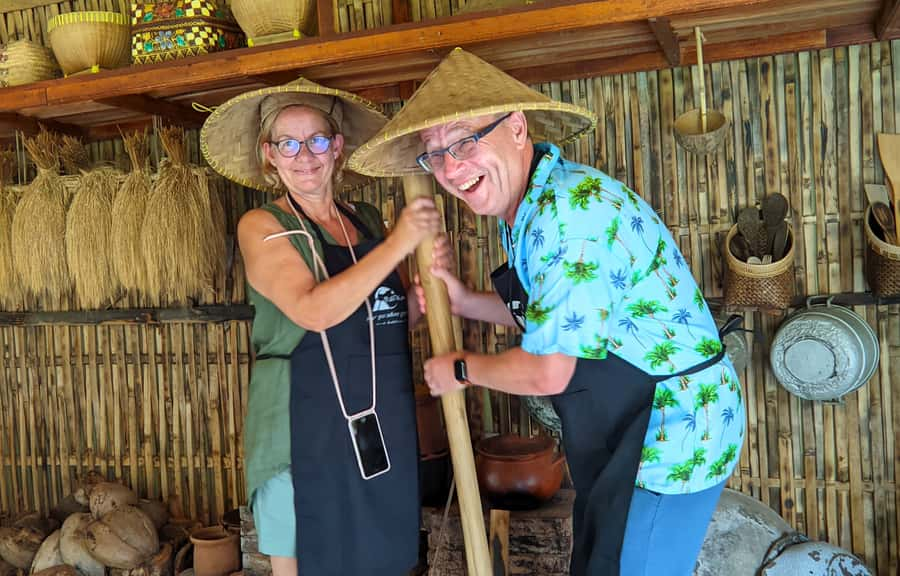
I would recommend this to people who want to understand Bali through food and farming, not only through temples and beaches. It works particularly well for curious cooks, families with older children who can manage the walking, and people staying in Ubud or the southern resort area who want a countryside day with transport included.
Beginners are welcome. You can work at your own pace, and staff can help with chopping and cooking. The variety also keeps the day moving: music, gardens, jamu, cooking, lunch, farming, animals, bees, architecture, and hot water.
I would think twice if you have limited mobility, serious food allergies, or very little patience for group activities. The group may reach around 11 people, and the program is full. You should also be comfortable with outdoor heat, uneven ground, and a downhill walk.
Should You Book the Balikaru Village Experience?
Book it if you want a hands-on rural day that combines food, farming, and village life in one well-supported outing. The strongest parts are the cooking class, the jamu preparation, the rice terrace walk, and the practical contact with farm animals and stingless bees.
Skip it if you want a quiet, short lesson or a tightly controlled private tour. Confirm your pickup location, mention dietary needs in advance, wear shoes suited to uneven paths, and allow for the possibility that the flower market may be replaced by a local market. At $61, the program offers a lot, but you should come ready for a busy day rather than a passive sightseeing ride.
FAQ
How much does the Pure Bali Village Experience cost?
The price is $61 per person.
How long does the experience last?
It is a full-day experience. Starting times vary, so you should check availability for the date you want.
Is hotel pickup included?
Yes. Pickup and return transfer in an air-conditioned vehicle are included from locations within 50 kilometers east and south of Belulang village, including Ubud, Candi Dasa, Sanur, Tanjung Benoa, Nusa Dua, Jimbaran, Uluwatu, Tuban, Kuta, Legian, Seminyak, Canggu, Denpasar, and Tanah Lot.
Do I need to provide my hotel location?
Yes. You must specify your pickup location when booking. Without that information, you may need to reach the activity starting point yourself.
Which languages are available?
Live guides are available in English, German, Italian, and French. Languages other than English may involve an extra charge.
What food will I prepare?
The cooking class can include Balinese spice paste, two sambals, steamed chicken in banana leaves, chicken sate lilit, tempeh, vegetable dishes, fern, and a traditional dessert such as lak lak.
Can vegetarian dietary needs be accommodated?
Yes. Vegetarian requirements can be accommodated if you state them under special requirements when booking.
Is the experience suitable for people with mobility impairments?
No. The experience is not suitable for people with mobility impairments or wheelchair users. It includes rice terrace paths, village walking, and a downhill walk of about 30 minutes.
Is bathing at Belulang Hot Spring required?
No. The hot spring visit includes an optional bath. Your driver waits there for the return transfer to your hotel.
More Private Drivers in Indonesia
- Pure Bali Village Experience, Cooking & Jamu Class+VIP Transfer
★ 5.0 · 16 reviews - Hoi An: Vegetarian Cooking Class w Local Family and transfer
★ 4.9 · 145 reviews - Hoi An: Cooking Class + basket boat (free transfer in Hoian)
★ 4.6 · 22 reviews - Sorrento: Italian Cooking Class with Transfer
★ 4.7 · 18 reviews
Just added around Indonesia
- Pure Bali Village Experience, Cooking & Jamu Class+VIP Transfer★ 5.0 · 16 reviews
- Spice Garden, Jamu & Cooking Class in Bali Village★ 5.0 · 5 reviews
- The Authentic Balinese Cooking Experience★ 5.0 · 4 reviews
- Seminyak : cooking class traditional food bali★ 5.0 · 5 reviews
- Seminyak: Vegetarian Cooking Class★ 5.0 · 3 reviews
- Quad ride, waterfalls & aunthentic cooking class in munduk★ 4.9 · 53 reviews
- Ubud: Organic Farm Harvest, Bali Cooking Class by Pemulan★ 4.8 · 12 reviews
- packages cooking class and romantic dinner in a local home★ 5.0 · 4 reviews
Farm & Countryside Cooking Classes, compared.

Half-Day Thai Cooking Class at Organic Farm in Chiang Mai
Read our review →
Cooking Class and Lunch at a Tuscan Farmhouse with Local Market Tour from Florence
Read our review →
Authentic Cooking Class with Market & Farm Visit
Read our review →