REVIEW · UBUD, INDONESIA
Balinese Ubud cooking school (9 Dish Cooking and Market Tour)
Come hungry, leave with recipes. This Ubud cooking class packs a lot into about five hours, combining a local market visit, rice paddies, Balinese food preparation, and a generous cooked meal. I like the chance to prepare nine Balinese classics rather than just one or two dishes, and I like the friendly, often funny teaching style of instructors such as Yogi, Putu, and Gus. The main drawback is transport: the class may involve a long drive beyond central Ubud, and pickup is included only within the Ubud area.
The morning option gives you the fullest cultural outing, with a market visit and rice-field stop before cooking. The afternoon option skips the market but includes making a Balinese offering. You should also expect a group setting, with up to 14 people, and some ingredients may already be prepared so the class can cover its large menu.
Key points to know before booking
- Nine dishes in one class: Prepare meat or vegetarian versions of Balinese soup, satay, lawar, sambal, dessert, and more.
- Morning is the better choice for culture: Visit a local market, sample unfamiliar fruit and sweets, and stop at rice paddies.
- The food is the main event: You eat the meal you help prepare, with enough food that some people pack leftovers.
- A friendly family-style setting: Instructors and kitchen staff are praised for warmth, humor, and clear guidance.
- Pickup has limits: Central Ubud pickup is included, while transport from outside Ubud costs extra and must be arranged in advance.
- Come ready for spice and a full meal: The kitchen can adjust seasoning, but the menu remains firmly Balinese.
Why this class offers more than a standard cooking lesson
Many cooking classes teach three or four dishes. This one aims for nine recipes, which explains both its popularity and its five-hour length. You are not simply watching a chef prepare food. You work through the ingredients, cooking methods, and seasoning under instruction, then sit down to eat the results.
The menu also gives you a useful introduction to the structure of Balinese cooking. You work with base gede, a basic spice paste used in many local dishes, and learn how sambal matah gets its fresh flavor from raw spices and coconut oil. These are the sorts of foundations that help you cook other Balinese meals later.
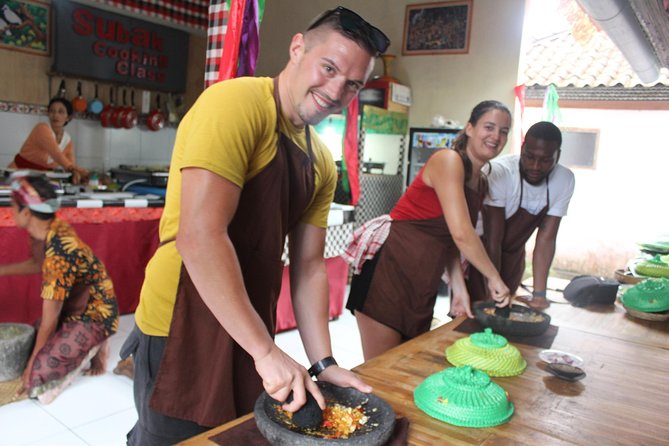
The class is best understood as a shared kitchen session rather than a private lesson. People commonly cook in pairs or at individual stations around a larger table. That arrangement lets you handle the fun parts while staff help with preparation and timing.
One point needs a little care. The advertised menu lists nine main recipes, but it also includes the spice paste, sambal, rice, and dessert. You will prepare and taste a large range of food, but not every component receives the same amount of hands-on work. One unhappy participant felt too much preparation had been done in advance and found it hard to hear the instructor. That is worth keeping in mind if you want a slow, highly technical chef’s course.
More Cooking Classes with a Market Tour in Indonesia
- Ubud: Cooking Class with Transfers and Optional Market Visit
★ 4.9 · 824 reviews - Ubud: Balinese Cooking Class and Market Tour
★ 4.8 · 531 reviews - Balinese Cooking class with traditional morning market visit
★ 5.0 · 161 reviews
The morning market sets the tone
Choose the morning class if you want the wider outing. The day begins with a visit to a local market, where a Balinese guide explains the produce, spices, fruit, sweets, and cooking ingredients used in the class.
This is not just a shopping stop for the kitchen. You get a look at how people buy and sell everyday food, and you may be offered samples of unfamiliar fruit, pastries, and local snacks. One particularly useful detail is the chance to see flower offerings being assembled, connecting the food market to daily religious life in Bali.
Guides such as Wayan and Tata have been praised for explaining more than the names of ingredients. They discuss local food customs, religion, cooking, and the way produce is used at home. If you enjoy asking questions, this is the part of the morning where you can get the most from your guide.
The market can also be a little eye-opening. It is a working local market, not a polished food hall designed for sightseeing. Bring your camera if you want photos, but be respectful, especially around people preparing offerings and selling food.
Rice paddies and a look beyond Ubud
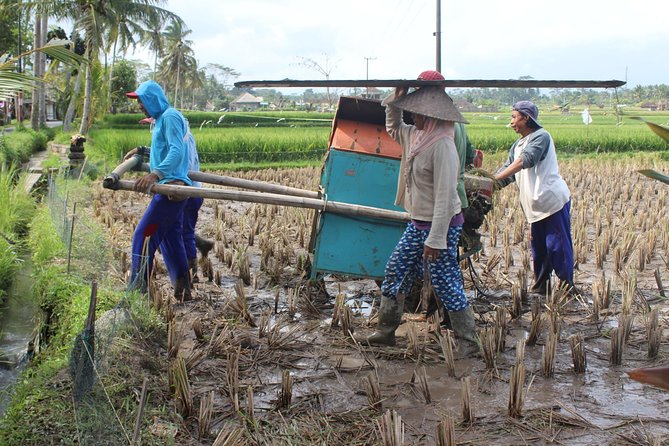
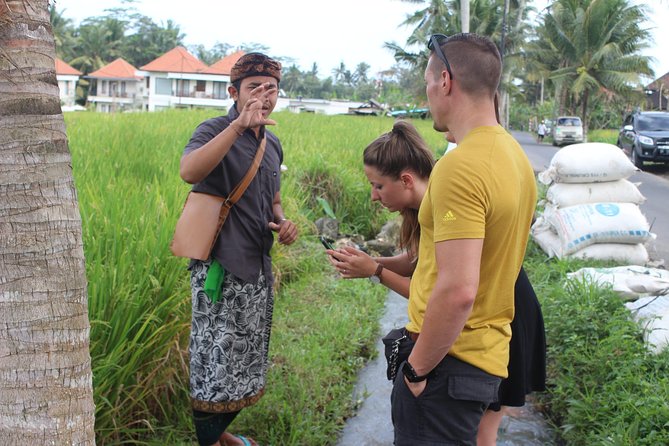
After the market, the morning program includes a visit to rice paddies. The stop gives you a chance to see where one of Bali’s most important foods is grown and to ask about planting and harvest cycles.
The guide may explain the different kinds of rice used in Bali and how long the crop takes to harvest. Some outings also provide views toward the volcano, depending on the exact route and weather. You should treat this as a short cultural and scenic stop, not a full rice-farming tour.
This part adds context to the meal later. Rice is not just a side dish in Bali, and seeing the paddies helps connect the white rice on your plate with the work behind it. It also breaks up the drive before you reach the cooking school.
The transport details matter here. The listed meeting point is Ubud Palace, and included pickup applies to the Ubud area. If you are staying outside Ubud, you need to request a pickup and pay an additional charge. One participant reported a drive of about 50 minutes from the meeting point to the cooking area, so allow more time than the five-hour activity label alone might suggest.
A Balinese home becomes the cooking school
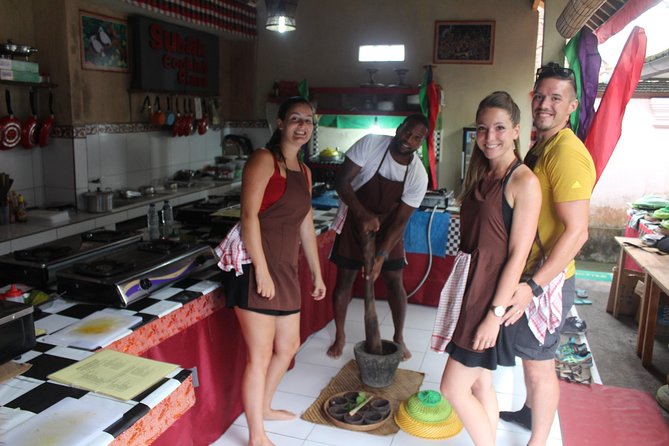
The class takes place in a Balinese home arranged as a cooking school. That setting helps the lesson feel connected to ordinary household cooking rather than a hotel demonstration kitchen.
The room can be lively, especially when several people are cooking at once. Instructors have been praised for keeping the mood light and helping each pair through the recipes. Yogi, in particular, is often described as funny, warm, and clear in his instructions, though the instructor can vary by date.
You use the provided equipment and ingredients, and bottled water is included. The staff handle much of the cleanup, which is good news after preparing a table full of food. You should still expect a busy session, with several recipes moving forward at once.
The best advice is to listen closely at the start of each dish. When a class covers this many recipes, instructions move quickly. If you are seated far from the chef or the room becomes noisy, ask for a repeat rather than quietly guessing. One poor experience involved loud conversations in the kitchen and trouble hearing the teacher.
More Cooking Classes with a Market Tour in Ubud
- PRIVATE Ubud Market Tour & Balinese Cooking Class with Putu
★ 5.0 · 125 reviews - Jambangan bali cooking class with morning market tour
★ 5.0 · 35 reviews - Balinese cooking class/Go shopping at the market, cook, eat
★ 5.0 · 12 reviews
The nine-dish menu, explained
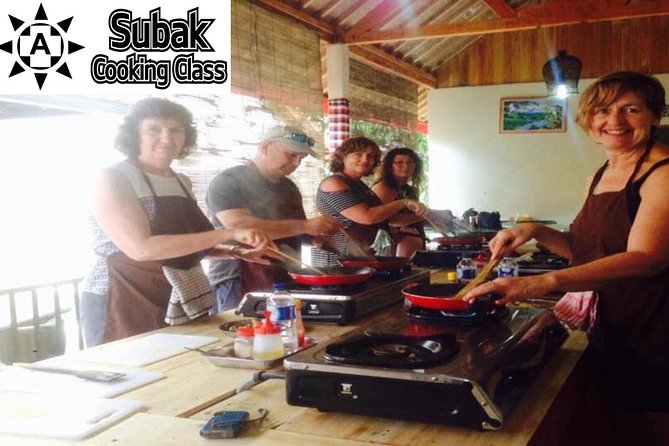
The regular menu is built around chicken, tempe, vegetables, coconut, and spice. It includes:
- Balinese vegetable soup
- Fried chicken with Balinese coconut sauce
- Sweet fried tempe
- Balinese chicken satay, known as sate lilit
- Chicken steamed or grilled in banana leaf
- Lawar, a vegetable mixture with Balinese spices
- Sambal matah
- Base gede spice paste
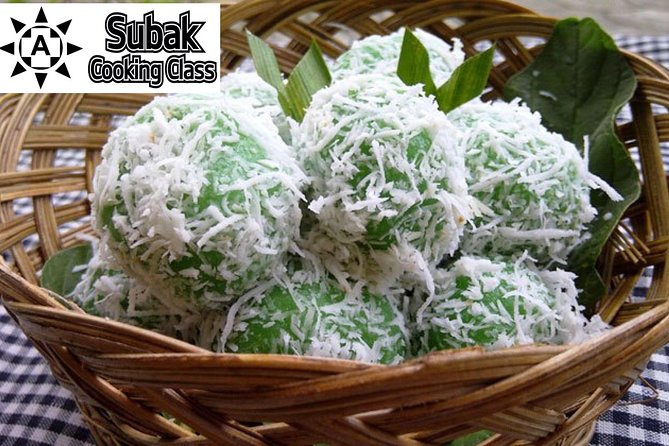
- Klepon, a sticky rice flour cake filled with palm sugar
White rice accompanies the main dishes. The menu gives you several different cooking methods in one sitting: frying, steaming, grilling, pounding or mixing spice pastes, and assembling fresh sambal.
Sate lilit is especially useful for understanding how Balinese satay differs from the familiar skewered cubes found elsewhere. The mixture is shaped around a skewer, while pepes ayam uses banana leaf to hold the chicken and seasoning during cooking. These are memorable techniques, and the recipes are practical enough to try at home if you can find the ingredients.
Klepon provides a sweet finish. The little rice flour cakes are boiled and filled with palm sugar, giving you a dessert technique that is quite different from the savory dishes earlier in the class.
Vegetarian cooking is a real alternative
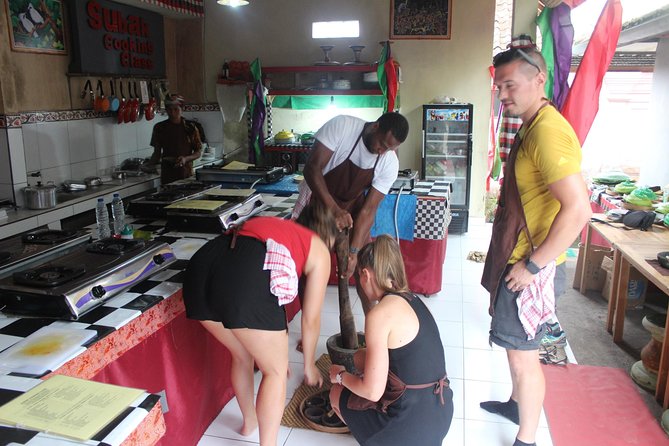
You do not have to choose the meat menu. The vegetarian version replaces chicken with tofu and tempe while keeping the overall structure of the class.
The vegetarian menu includes vegetable soup, tofu with Balinese sauce, sweet tempe, tempe satay with peanut sauce, tofu steamed or grilled in banana leaf, lawar, sambal matah, base gede, klepon, and white rice.
This is more than a token substitute. You still prepare a broad group of dishes and get to work with the same core flavors. Tell the operator your choice when booking, and double-check your selection before the class begins.
The kitchen can also adjust spice levels. One participant prepared a milder version while others in the group preferred more heat. That flexibility is useful, but you should not expect a completely spice-free menu. Sambal and Balinese spice pastes are central to the meal.
Eating the meal is part of the lesson
Once the cooking is complete, the class becomes lunch or dinner. You eat the food prepared by the group, served as a shared meal or buffet-style spread.
This is where the large menu pays off. You get to compare the dishes, notice how the same spice base works in different recipes, and see which recipes you want to repeat at home. The food is often described as fresh, plentiful, and similar to what you would receive at a Balinese restaurant or food stall.
Come with an empty stomach. Nine dishes, rice, market samples, and dessert add up quickly. If you cannot finish, the staff may let you pack food to take back to your hotel, though you should bring this up with them rather than assume it is guaranteed.
The meal also creates a social finish. You are eating with the other people from the class, so this suits you if you enjoy a communal setting. It is less ideal if you want a private dinner or a quiet one-on-one lesson.
Afternoon option: offering-making instead of the market
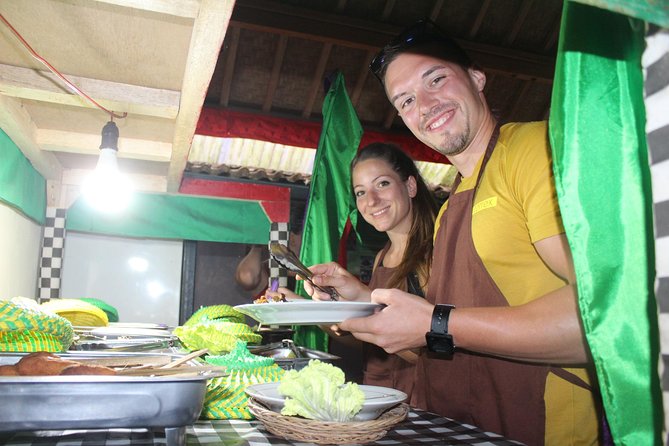
The afternoon program has a different focus. It does not include the traditional market visit. Instead, it includes making a Balinese offering.
That option may suit you if you prefer the cooking class itself or if your schedule does not allow an early start. Making an offering adds a cultural activity, but you will miss the market and rice-field portions listed for the morning program.
Choose carefully at booking. The morning and afternoon schedules are not interchangeable, and the market visit is available only with the morning class. If the market is a priority, do not select the afternoon departure simply because it fits your day more easily.
Price, group size, and practical value
At $58, this is not the cheapest cooking lesson you will find in Bali. Still, the price includes a five-hour outing, a guide, transport within Ubud, market and rice-field visits on the morning program, cooking instruction, equipment, bottled water, recipes, and a full meal.
I think the value is strongest when you choose the morning class and use the day as a compact introduction to Balinese food and village life. A simple cooking class may cost less, but it will not necessarily include the market, paddies, local guide, and transport between stops.
The group limit is 14 people. That is small enough to feel manageable, but it does not guarantee a private station with constant chef attention. Several people have praised the number of cooking stations and the hands-on format, while one person found the room too noisy. Your experience may depend on the group size and where you are positioned.
Pickup is included only in Ubud. If you stay in Nusa Dua or another area outside Ubud, ask about the extra transport cost before booking. One account also raised a concern about a driver and a toll-road payment, so confirm any added road charges clearly before setting off.
You receive a copy of the recipes to take away. Keep it safe, since the real value of a cooking class comes after Bali, when you try to recreate the food for friends and family.
Who should book this Ubud cooking class?
I would recommend it to food lovers who want a full half-day rather than a brief demonstration. It also works well for couples, families, and mixed-age groups, since the instructors keep the atmosphere relaxed and the work can be shared.
It is a good fit if you want to learn about ingredients in their local setting, taste new fruit, and eat a large meal at the end. Vegetarians also have a substantial menu, not just a plate of rice and vegetables.
You may want another class if you dislike group activities, need a very quiet teaching environment, or want to personally chop and measure every ingredient from start to finish. The large menu requires advance preparation, and the long transfer from some parts of Bali can reduce the time available for cooking.
Should you book it?
Yes, if you want lots of food, friendly instruction, and cultural stops in one Ubud outing. Choose the morning schedule, meet at Ubud Palace as instructed, and confirm pickup if you are staying outside the Ubud area.
I would book this for the market, rice paddies, and generous nine-dish meal as much as for the recipes. Just keep your expectations realistic: it is a lively shared class, not a private culinary school. If that sounds right for you, $58 is fair value for a five-hour taste of Balinese food and daily life.
FAQ
Where does the experience start?
It starts at Ubud Palace, at F7V7+72R, Jl. Raya Ubud No. 8, Ubud, Bali.
Where does the experience end?
The activity ends back at the meeting point.
How long does the cooking experience last?
The full activity lasts approximately five hours.
Is pickup included?
Pickup and drop-off are included for the Ubud area. Pickup from outside Ubud requires an additional charge and must be requested in advance.
Does every class include a market visit?
No. The traditional market visit is provided only with the morning class.
What does the morning option include?
The morning option includes the market visit and a rice-paddy visit, along with the cooking class and meal.
What does the afternoon option include?
The afternoon option includes making a Balinese offering instead of the morning market visit.
Can I choose a vegetarian menu?
Yes. A vegetarian menu is available and includes tofu, tempe, vegetable dishes, sambal, spice paste, klepon, and rice.
Is food included?
Yes. Bottled water, food tasting, and lunch or dinner made during the class are included.
How many people can join the class?
The activity has a maximum of 14 participants.
What should I bring?
Bring your booking reservation, a camera, and cash if you need to pay an additional transport charge from outside Ubud. Wear normal comfortable clothing.
Can I cancel for a full refund?
Yes, if you cancel at least 24 hours before the experience start time. Cancellations or changes made less than 24 hours before the start time are not accepted for a refund.
More Balinese Cooking Classes in Ubud
- Ubud Cooking Class Bali with Balinese Chef
★ 5.0 · 1,609 reviews - PRIVATE Authentic Balinese Cooking Class in Ubud at Putu’s Home
★ 5.0 · 644 reviews - Balinese Farm Cooking Class by Pemulan Bali
★ 5.0 · 410 reviews - Balinese Authentic Cooking Class in Ubud
★ 5.0 · 239 reviews
Just added around Ubud
- The Authentic Balinese Cooking Experience★ 5.0 · 4 reviews
- Ubud: Organic Farm Harvest, Bali Cooking Class by Pemulan★ 4.8 · 12 reviews
- packages cooking class and romantic dinner in a local home★ 5.0 · 4 reviews
- Jambangan bali cooking class with morning market tour★ 5.0 · 35 reviews
- Ubud: Balinese Cooking Class with Hotel Transfers★ 4.8 · 17 reviews
- Bali: Cooking Class with Monkey Forest and Art Village Tour★ 5.0 · 2 reviews
- Balinese cooking class/Go shopping at the market, cook, eat★ 5.0 · 12 reviews
- PRIVATE Ubud Market Tour & Balinese Cooking Class with Putu★ 5.0 · 125 reviews
Cooking Classes with a Market Tour, compared.
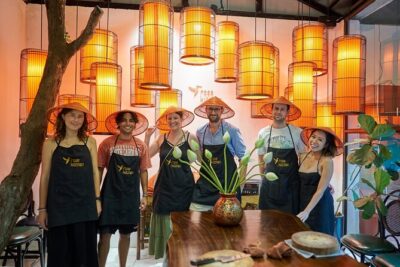
Hanoi Cooking Class: Culture, Local Market & Meaning CSR Impact
Read our review →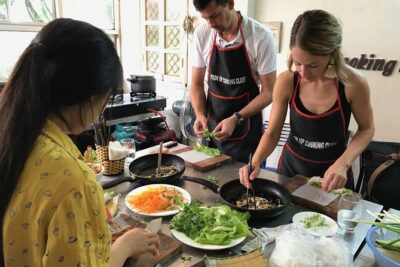
5 Traditional Dishes Hanoi Cooking Class with Market Trip
Read our review →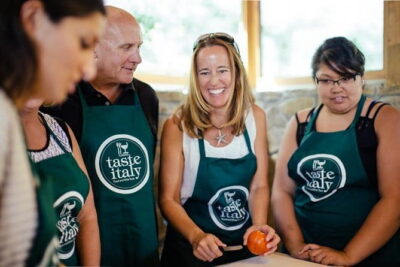
Cooking Class and Lunch at a Tuscan Farmhouse with Local Market Tour from Florence
Read our review →
Cooking Class, Market & Thai Herbs Garden Tour
Read our review →
Authentic Cooking Class with Market & Farm Visit
Read our review →
Paella Cooking Experience & Boqueria Market Tour
Read our review →
Cooking Class Hoi An:Local Market, Basket Boat, Fishing & Cooking
Read our review →