
REVIEW · SOUTH KOREA
Busan: Small-Group Traditional Korean Food Cooking Class
Korean food makes a fine souvenir. This three-hour cooking class near Haeundae Beach gives you more than a meal: you learn how Korean sauces work, cook bibimbap with fresh seasonal ingredients, and sit down to eat at a traditional bapsang table. I like the small class size and the warm, clear teaching from Min, whose English is easy to follow. I also like the full meal at the end, with tea, dessert, recipes, a certificate, and a small surprise gift included.
The main drawback is the price: $98 per person is a serious spend for a cooking lesson, especially if you are traveling on a tight budget. You also need to make your own way to Marine City, and the exact dishes may vary. Still, for a hands-on introduction to Korean food culture, the price includes plenty: ingredients, instruction, a three-course-style meal, drinks, dessert, and take-home recipes.
Key points at a glance
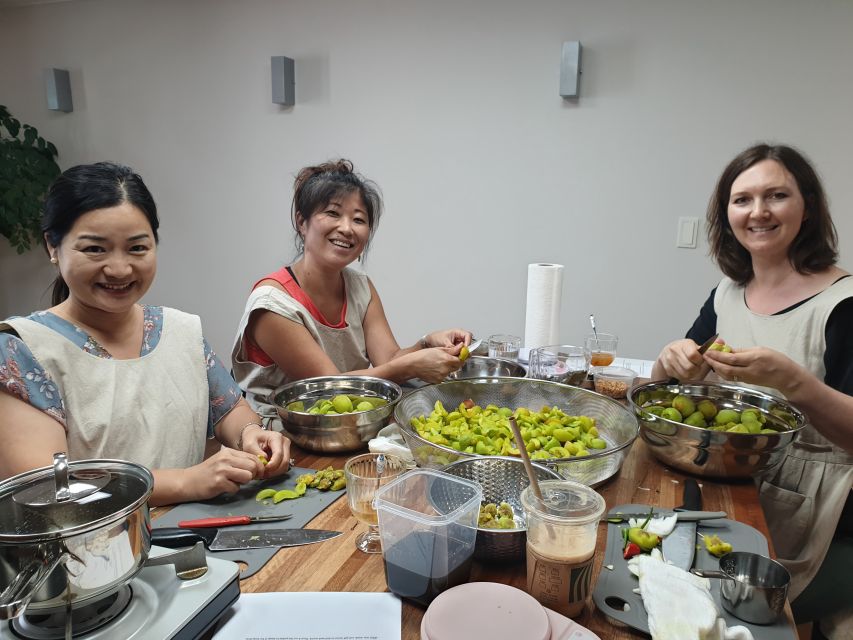
- Cook bibimbap from the ground up: You prepare a Korean rice dish with vegetables and meat, then eat the finished meal yourself.
- Expect more than one dish: Classes have included bibimbap, miyeok guk seaweed and beef soup, and buchu jeon vegetable fritters.
- Learn from Min: She explains cooking steps, food customs, and dish history in clear English and Korean.
- Eat at a bapsang: Your finished food is arranged on a traditional personal dining table, giving the meal a cultural setting as well as a practical one.
- Finish with tea and dessert: Korean sweets and traditional tea round out the lesson.
- Convenient Haeundae setting: The class is near the beach, with access by Dongbaek Station and several local bus routes.
A small class near Haeundae Beach
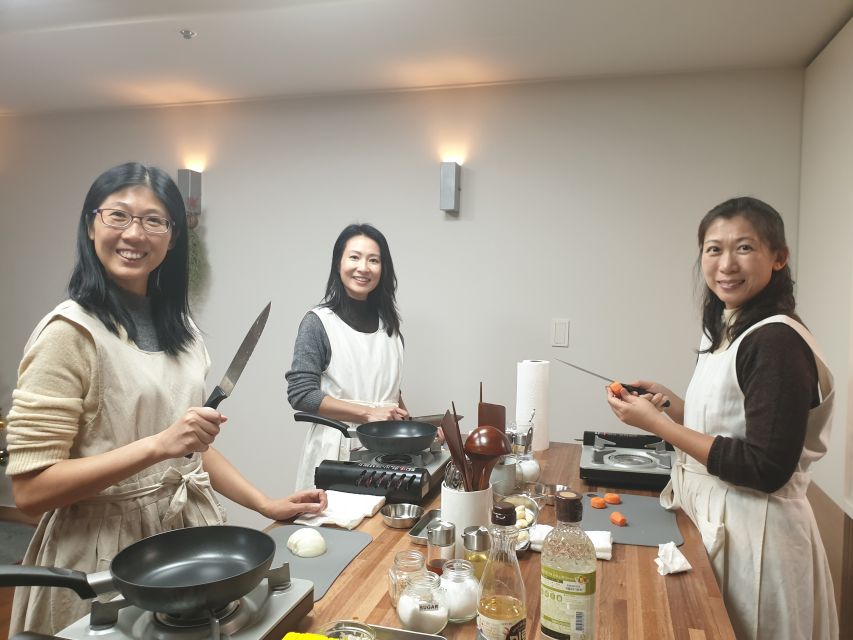
The cooking studio is at Flat 2406 in Hoabin Busan Haeundae, at 37 Marine City 3-ro. This puts you in Marine City, a modern part of Haeundae, with the famous beach area close by.
The nearest subway stop is Dongbaek Station on Busan Metro Line 2. From Exit 1, allow about 10 minutes on foot. You can also walk from Daewoo Marina Apartment bus stop in about seven minutes, or from Dongbaek bus stop in roughly 15 minutes.
There is no hotel pickup or drop-off. That is not unusual for a city cooking class, but it matters when planning your morning. I would allow extra time to find the correct building and apartment. You are visiting a residential-style high-rise setting rather than a large restaurant or public cooking school, so check the address carefully before setting out.
The Haeundae location works well as part of a wider day. You can place the class before or after time at the beach, Dongbaek Island, or Marine City. The activity itself lasts three hours, so it takes a meaningful part of your day without swallowing the whole schedule.
More Korean Cooking Classes in South Korea:
- Local Home Korean Cooking Class & Market Adventure in Seoul
★ 5.0 · 1,024 reviews - Master Korean traditional cooking with a Kimchi chef
★ 5.0 · 385 reviews - Seoul: Korean Cooking Class at a Local Home and Market Tour
★ 5.0 · 348 reviews
What happens when you arrive
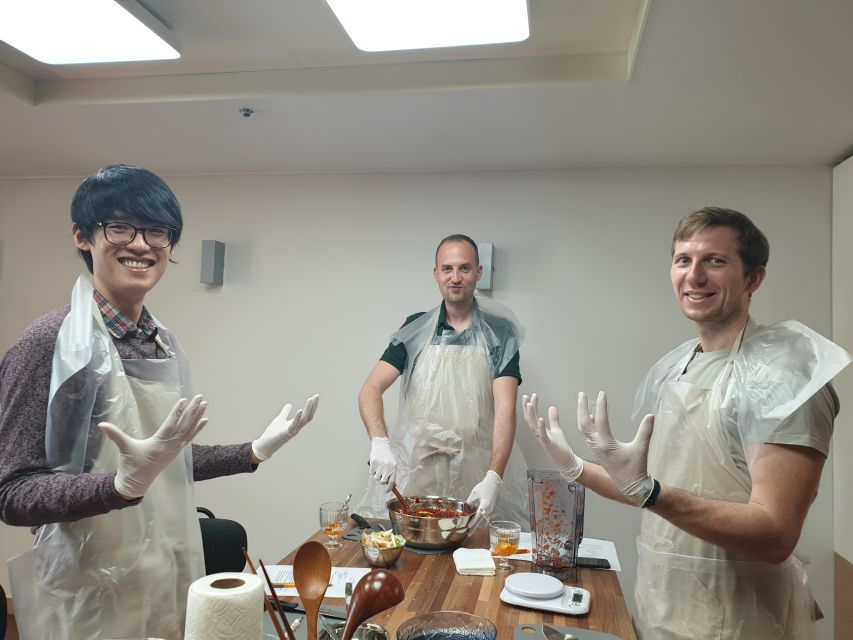
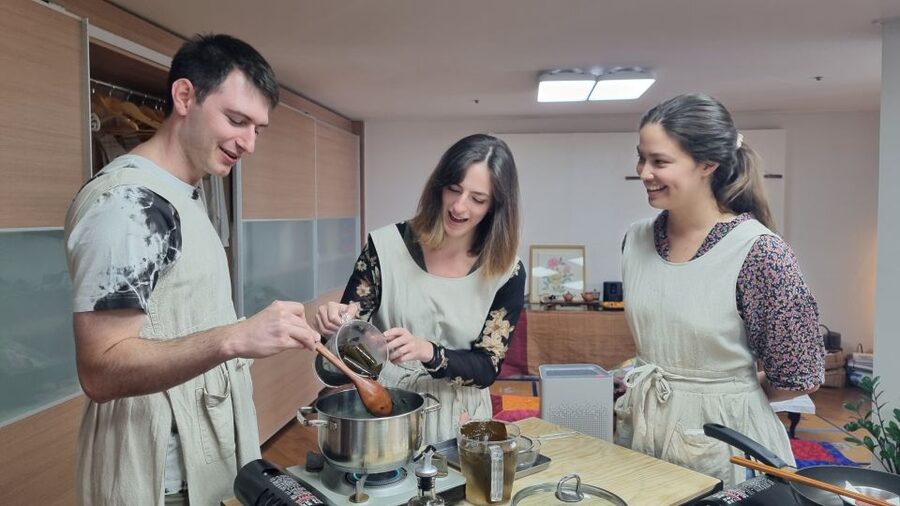
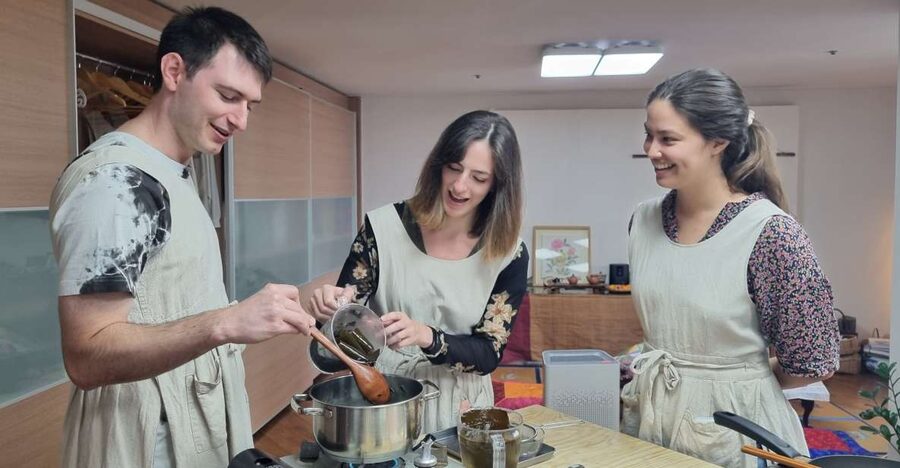
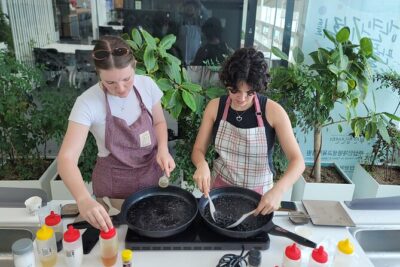
The class begins with a welcome drink. This gives you a calm start before the knives and hot pans appear, and it allows the instructor to introduce the ingredients and the plan for the meal.
One of the best parts is the tasting session before cooking begins. You sample Korean sauces and learn how they add salt, heat, sweetness, and depth to a dish. That small step has real value because Korean food can look simple on the plate while depending on carefully balanced condiments.
The chef explains the ingredients before you begin. You are not simply handed a printed recipe and left to copy someone else. The format is designed for participation, with easy instructions and step-by-step guidance.
Min receives the strongest praise in the available feedback. She is described as warm, well organized, easy to understand, and generous with explanations. She also offers suggestions for things to see and do around Busan, which is a useful extra if this is one of your first days in the city.
The instructor is available in English and Korean. English-speaking visitors should find the class accessible, especially because the cooking process is shown as well as explained.
Making bibimbap, Korea’s practical rice classic
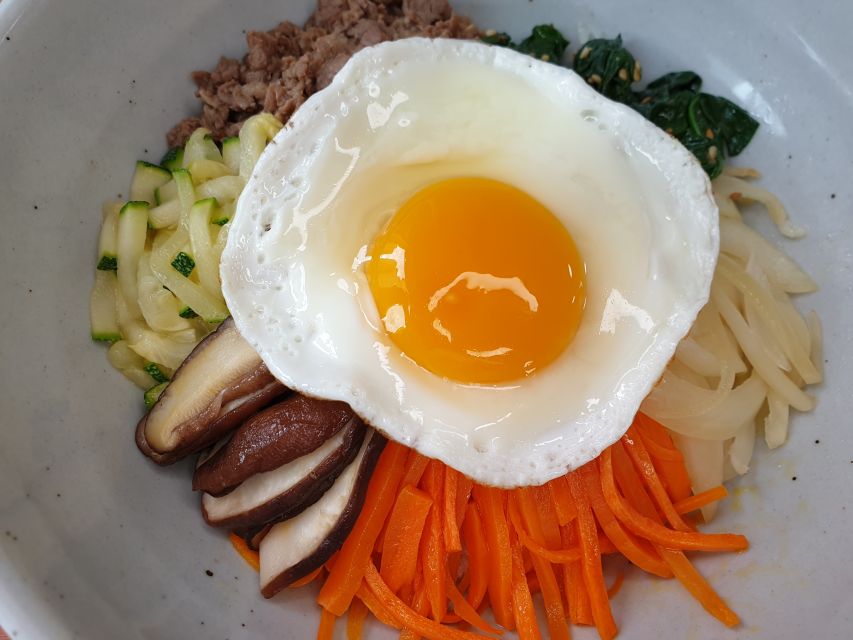
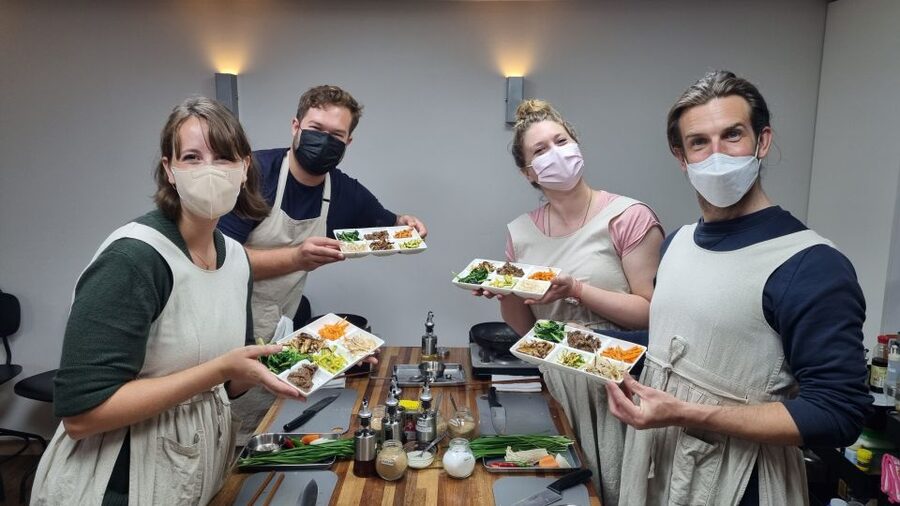
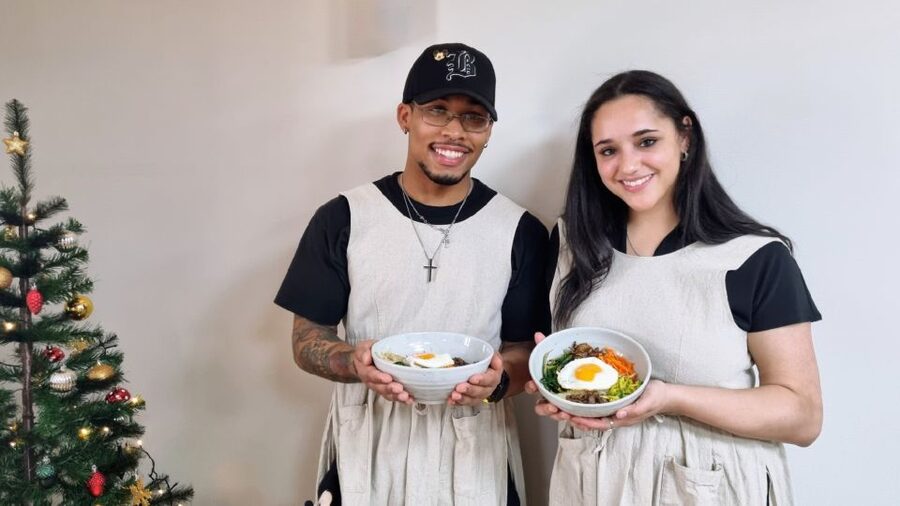
Bibimbap is the central dish advertised for the class. The name refers to mixed rice, and the basic idea is wonderfully practical: rice, vegetables, meat, and sauce come together in one bowl.
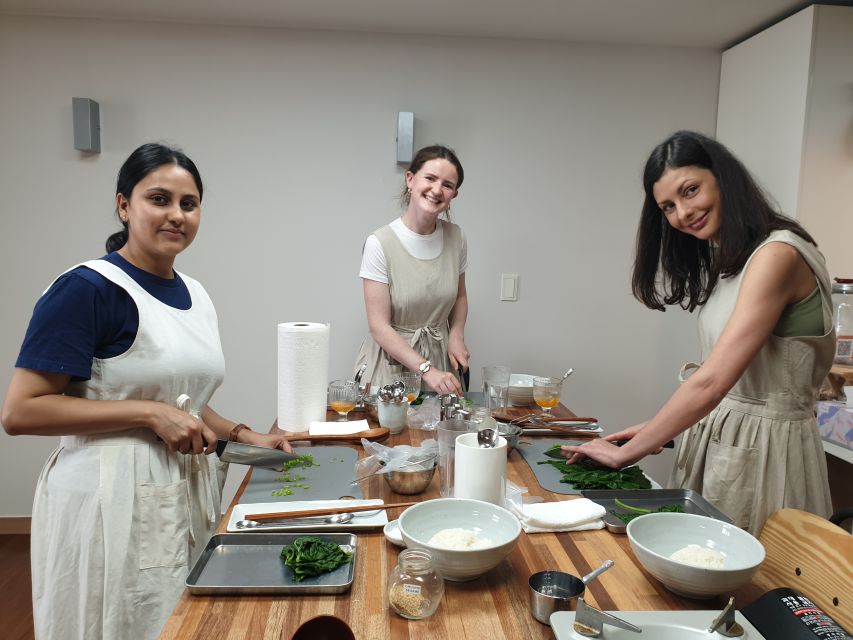
You learn how the separate parts are prepared and then combine them into a finished dish. That makes bibimbap a good teaching recipe. It introduces you to Korean seasoning without requiring a long or overly technical cooking process.
The class uses fresh local seasonal ingredients. Seasonal cooking means the exact produce and menu can change, but it also gives you a closer look at how Korean home cooking works in real life. You are learning a method, not just assembling a fixed tourist menu.
Past class menus have included three dishes: bibimbap, miyeok guk, and buchu jeon. Miyeok guk is seaweed and beef soup, while buchu jeon is a savory vegetable fritter. These dishes broaden the lesson beyond one famous bowl and show different parts of a Korean meal.
The food is prepared in a manageable time. A three-hour class has to balance instruction, cooking, eating, and conversation, and the selected dishes appear designed for that rhythm. You get enough variety to understand a meal without spending the entire morning waiting for one complicated recipe.
Eating at a traditional bapsang table
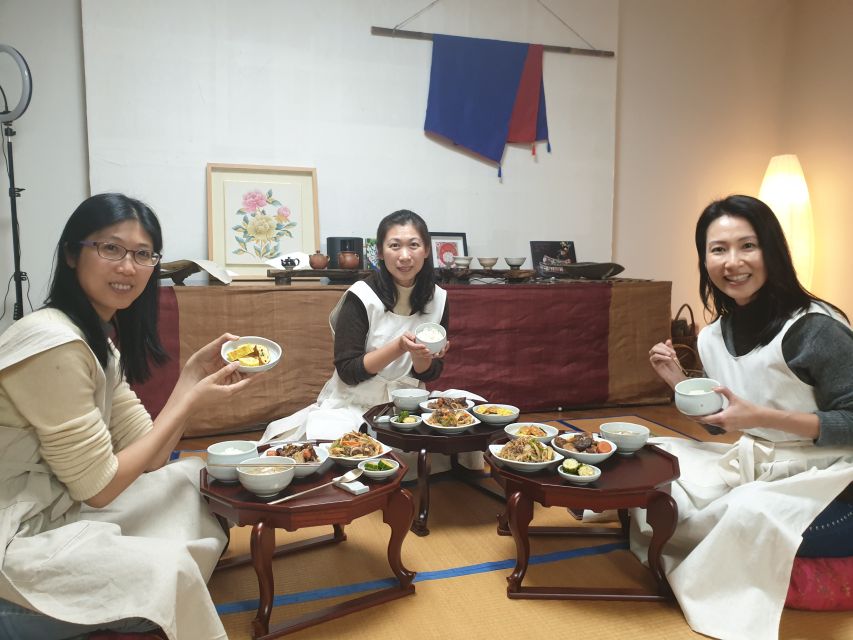
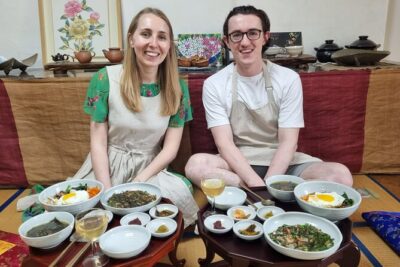
Once the cooking is complete, you place your food on a bapsang. A bapsang is a traditional personal dining table, a compact setting for a Korean meal.
This detail gives the class a stronger cultural focus. You are not just eating at a counter after a lesson. You see how your dishes come together as a personal meal, with the food arranged for eating rather than for a cooking demonstration.
The meal is included in the price, along with water and dessert. That matters when you compare the $98 cost with an ordinary restaurant meal. You are paying for instruction and participation, but you also receive a substantial lunch or breakfast replacement.
The food has earned very strong praise. Past participants have repeatedly described it as delicious, flavorful, and representative of Korean meals. That does not mean every dish will suit every palate. Korean sauces can be unfamiliar if you are used to milder seasoning, which is why the early tasting is useful.
You also get to eat what you made. That sounds obvious, but it changes the mood of the class. The meal becomes a reward for your work, and it gives you a chance to compare the finished dish with the ingredients and sauces you tasted earlier.
More Food and Drink Trips in South Korea:
- Busan Local Food Cooking Class with Market Tour
★ 5.0 · 53 reviews - Vegan Friendly Korean Food Cooking Class
★ 5.0 · 2 reviews - Small Group Cooking Class & Market Food Tour in Florence
★ 5.0 · 1,574 reviews - Pasta Making & Wine Tasting with Dinner in Frascati from Rome
★ 5.0 · 1,326 reviews
Tea, Korean dessert, and the quieter finish
After the main meal, the class moves to tea and Korean dessert tasting. This is a pleasant change of pace after cooking and eating savory dishes.
The dessert portion is not just an extra sweet course. It gives you another small window into Korean food culture, where tea and sweets can be part of a relaxed social ending rather than a rushed final bite.
The tea and dessert are included, as are the recipes you take home. You also receive a certificate and a surprise gift. The certificate may not matter to every person, but the recipes have clear practical value. They help you repeat the dishes at home while the method is still fresh in your mind.
If you enjoy food souvenirs that do not take up space in your suitcase, a recipe booklet is more useful than another decorative trinket. The gift adds a pleasant personal touch, though I would treat it as a bonus rather than a reason to book.
Why the teaching matters more than the menu
A cooking class is only as good as its instructor. Here, the strongest feature is not simply the list of dishes but the amount of explanation around them.
Min explains the background of the food and the culture connected to it. Past participants have particularly valued the history behind the dishes, the clear instructions, and the chance to ask questions. She has also been praised for speaking English very well and for understanding different food cultures.
That cross-cultural awareness can make a real difference. A good teacher notices when a seasoning or cooking technique needs extra explanation for someone unfamiliar with Korean food. The class seems built around that kind of communication rather than assuming you already know what to do.
The experience also works for families. A 12-year-old attended with a parent and enjoyed the step-by-step format. Children still need to be comfortable taking part in a cooking lesson, but the class has shown that it can suit a parent and child traveling together.
The setting is small and personal. The stated group size is limited to nine participants, while the activity information also gives a maximum of 10. Because of that slight difference, I would confirm the exact group size when booking if a very small class is important to you.
Is $98 a fair price?
At $98, this is not a cheap way to eat in Busan. You can find a Korean meal for much less, and budget-minded visitors may prefer to spend the money on several restaurant meals.
The comparison changes when you count what is included. You receive:
- All cooking ingredients
- Use of utensils and an apron
- A prepared meal
- Water
- Korean tea and dessert
- Recipes to take home
- A certificate
- A surprise gift
- Three hours of instruction in a small group
You are also paying for access to a local teacher who can explain sauces, dish customs, and cooking methods. If you would like to cook Korean food again after your trip, that instruction has more lasting value than a single restaurant lunch.
I see the price as reasonable for someone who treats the class as both a meal and a cultural activity. It is less convincing for someone who mainly wants to taste Korean food without cooking. In that case, a market visit or restaurant meal will offer better value.
The class is also a useful choice for solo visitors. A small group creates room for conversation without the scale of a large tour. You may cook alongside people from several countries, then sit down together at the end.
Dietary requests and practical limits
If you need a vegan meal, you must request it when booking or contact the provider at least 24 hours before the class. Do not wait until arrival, since the ingredients need to be prepared in advance.
The supplied information confirms vegan arrangements but does not describe other dietary substitutions. If you have allergies or strict food restrictions, contact the provider before booking and ask what can be changed.
The class is wheelchair accessible. Pickup and drop-off are not included, so you are responsible for reaching the Marine City address.
Cancellation is flexible enough for most visitors. You can cancel up to 24 hours in advance for a full refund, and the reserve-now, pay-later option lets you hold a place without paying immediately. Starting times vary, so check availability for the date you want.
Who should book this Busan cooking class?
I would choose this class if you want to understand Korean food rather than simply photograph it. It suits curious eaters, solo visitors, couples, families with older children, and anyone who likes taking a practical skill home from a trip.
It is especially good for a first visit to Busan. Min’s local suggestions can help you shape the rest of your time, and the Haeundae location fits easily into a day around the coast.
I would hesitate if you dislike group activities, have very limited time, or are looking only for the cheapest meal. The class requires three hours, plus travel to and from Marine City, and the $98 price reflects teaching rather than just food.
Should you book it?
Yes, if you want a friendly, hands-on introduction to Korean cooking near Haeundae. The combination of bibimbap, additional dishes, sauce tasting, tea, dessert, recipes, and local food guidance gives the class more substance than a quick demonstration.
The clearest reason to book is the teaching. Min’s warm manner, strong English, and careful explanations turn the meal into a useful lesson. If you can accept the price and arrange your own transport, this is one of Busan’s better choices for learning by doing.
FAQ
How long does the cooking class last?
The class lasts three hours.
Where is the cooking class located?
It takes place at Flat 2406, Hoabin Busan Haeundae, 37 Marine City 3-ro, U 1(il)-dong, Haeundae, Busan, South Korea.
How do I reach the class by subway?
Take Busan Metro Line 2 to Dongbaek Station and leave through Exit 1. The meeting point is about a 10-minute walk away.
Is pickup and drop-off included?
No. You must make your own way to the meeting point.
What language is the class taught in?
The instructor teaches in English and Korean.
Can I request a vegan meal?
Yes. Request a vegan meal when booking or contact the provider at least 24 hours before the class.
Is the activity wheelchair accessible?
Yes, the activity is wheelchair accessible.
What is included in the price?
The $98 price includes ingredients, utensils, an apron, the meal, dessert, water, recipes, a certificate, and a surprise gift.
More Food Trips in South Korea
- Busan Tailored Korean cooking class (Vegan OK)with market tour
★ 5.0 · 66 reviews - Seoul: Temple Vegan Cooking Class & Oriental Medicine Tour
★ 4.6 · 32 reviews - Athens: Food Market Visit and Cooking Class with Wine
★ 4.9 · 1,087 reviews - Undiscovered Charleston: Half Day Food, Wine & History Tour with Cooking Class
★ 5.0 · 948 reviews
Just added around South Korea
- Busan Tailored Korean cooking class (Vegan OK)with market tour★ 5.0 · 66 reviews
- Vegan Friendly Korean Food Cooking Class★ 5.0 · 2 reviews
- Korean cooking class in Haeundae, Busan★ 5.0 · 92 reviews
- Busan Local Food Cooking Class with Market Tour★ 5.0 · 53 reviews
- Seoul: Korean Kimchi Cooking Class in the Heart of the City★ 5.0 · 3 reviews
- Seoul: Premium Korean Feast Cooking Class★ 5.0 · 3 reviews
- Seoul: Kimchi Dishes Cooking Class with Wine Pairing★ 4.7 · 38 reviews
- Seoul: Korean Cooking Class with Local Grocery Shopping★ 5.0 · 13 reviews
Korean Cooking Classes, compared.
Local Home Korean Cooking Class & Market Adventure in Seoul
Read our review →
Master Korean traditional cooking with a Kimchi chef
Read our review →
Korean Cooking Class at a Local Home and Market Tour
Read our review →
Busan Tailored Korean cooking class (Vegan OK)with market tour
Read our review →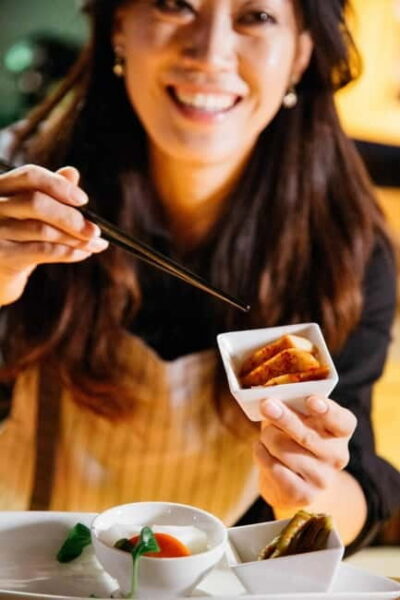
Lists this class appears in