
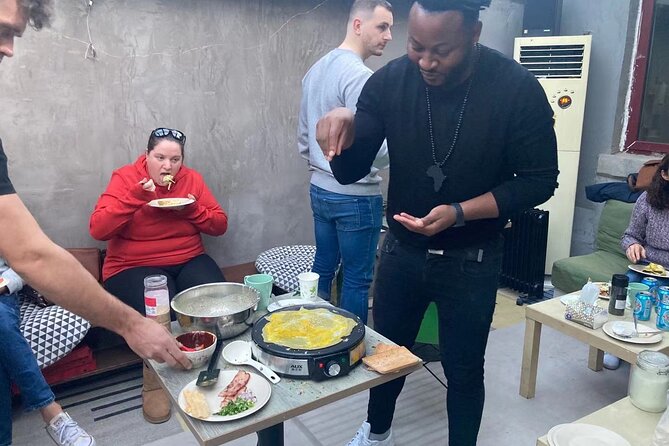
REVIEW · BEIJING, CHINA
China’s Favourite Street Food Cooking Workshop
Street food becomes your lunch lesson. This private Beijing workshop lets you make jian bing from scratch, then adjust it with savory or sweet fillings while an instructor guides your hands. I like the personal attention and the chance to make several attempts rather than watch a single demonstration. I also like that the class explains where this beloved street food comes from before putting you at the pan.
The main consideration is the price: $80 for about 90 minutes can feel high if you are booking alone, but it becomes more reasonable when shared by a private party. This is a cooking activity, not a broad hutong tour, so you should book it for food, participation, and a relaxed group outing rather than sightseeing.
Key points at a glance
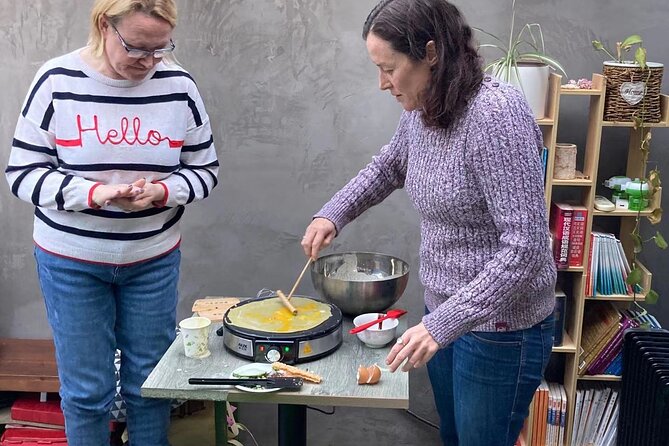
- You make the batter and cook the jian bing yourself, with help from the instructor when the technique gets tricky.
- Dom leads the class, explaining the food’s background in an entertaining, easy-to-follow way.
- Fillings range from traditional savory choices to chocolate and banana, giving you room to experiment.
- The private format suits families and friends, with only your party taking part.
- You can make as many jian bings as you want during the session, according to the detailed experience feedback provided.
- The workshop meets at 10 Shi Que Hu Tong in Dongcheng District and ends at the same place.
Why jian bing makes a good Beijing activity
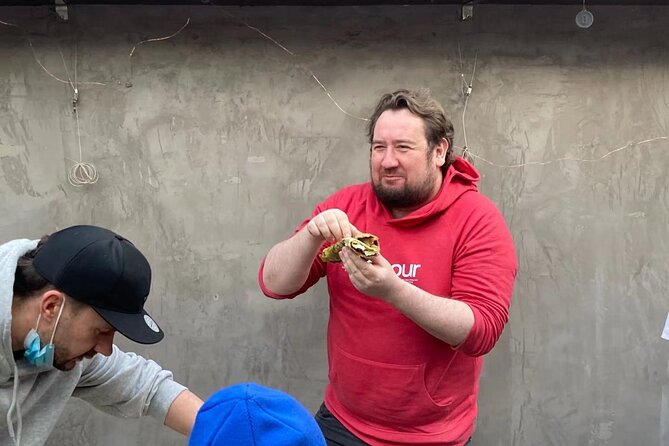
Jian bing is one of Beijing’s most familiar street foods. It is made from a thin batter cooked on a hot pan, then finished with fillings and sauces. You may see it prepared quickly at a street cart, with the vendor spreading batter, adding an egg, folding the crepe, and handing it over in minutes.
That speed can hide the skill involved. Getting the batter thin without tearing it takes practice. So does working quickly enough to add fillings before the pancake firms up. This workshop gives you time to slow the process down and understand what is happening.
I like this kind of food class because it connects a meal to daily life. You are not just sampling a dish in a restaurant. You are learning how a common breakfast or snack comes together, then eating the result while the process is still fresh in your mind.
The class also leaves room for personal taste. Traditional savory fillings are available, but you can try sweeter combinations as well. Chocolate and banana have been included among the options, which adds a playful twist to a food many people first encounter in its savory form.
More Food and Drink Trips in China:
- Small Group Cooking Class & Market Food Tour in Florence
★ 5.0 · 1,574 reviews - Pasta Making & Wine Tasting with Dinner in Frascati from Rome
★ 5.0 · 1,326 reviews - Paella Cooking Class, Wine Tasting & Central Market in Valencia
★ 5.0 · 1,150 reviews
Starting with the story behind the street food
The workshop begins with an explanation of where jian bing comes from. Dom, the instructor named in the detailed feedback, presents this part as an entertaining story rather than a dry lecture. That matters because the history gives the cooking a clear setting: this is food with a strong place in Beijing’s everyday culture.
You should not expect a long academic talk. The purpose is to give you enough background to understand why jian bing is so common and why its preparation has become such a recognizable street scene. Then the class moves on to making food.
This opening also helps children stay interested. Parents have used the workshop as a mid-day activity for middle-school-aged children, and the combination of a short story, hands-on work, and eating keeps the pace lively without requiring a full day of concentration.
Making the batter and learning the technique
The practical part begins with the batter. You get to take part in making the dough or batter, rather than receiving a ready-made mixture and only handling the pan. That gives you a better sense of the dish from beginning to end.
The technique is simple to describe but less simple to perform. You spread the batter across the hot cooking surface, aiming for a thin, even layer. Your first attempt may be uneven or too thick. That is part of the point. The instructor can step in, explain what to change, and let you try again.
I especially like that you are not limited to one ceremonial attempt. The experience allows you to make as many jian bings as you want during the session, giving you a chance to improve. The first one may be a lesson. The later ones should feel more controlled.
This format is useful for people who enjoy practical activities but do not consider themselves cooks. You do not need to arrive with special skills. You need enough patience to repeat the movement and listen to small corrections.
Cooking your own jian bing on the pan
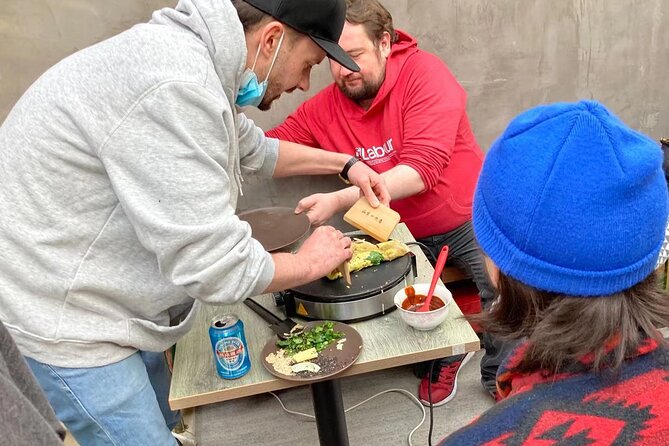
The pan is where the workshop becomes most active. You cook the jian bing yourself, rather than watching the instructor handle every step. That hands-on time is the strongest reason to choose this experience over a simple food tasting.
The class gives you room to learn through trial and error. You might spread the batter too slowly, leave a thicker patch, or struggle to keep the crepe intact as you fold it. None of these problems ruins the activity. In fact, they help you understand why street vendors make the process look easy.
The instructor remains available when you need help. The goal is not to test you or judge your cooking. It is to help you make something edible, recognizable, and enjoyable before the session ends.
Since the activity is private, you do not have to match the pace of an unfamiliar group. Your party can focus on its own attempts, ask questions, and spend more time on the steps that cause trouble. That is particularly helpful if some people in your group are children or first-time cooks.
More Food Trips in China:
- Flavors of Beijing: Eat Like A Real Chinese
★ 5.0 · 78 reviews - Shanghai-Cooking Dumpling & Meal in Local Family-w/Vegan
★ 4.9 · 36 reviews - Beijing: Vegan Home Cooking & Local Market Tour with Sanxia
★ 4.8 · 4 reviews - Athens: Food Market Visit and Cooking Class with Wine
★ 4.9 · 1,087 reviews
Filling choices, from savory to chocolate and banana
Once the base is cooked, you can choose fillings and flavors. Traditional savory ingredients are part of the selection, but the class also offers less expected combinations, including chocolate and banana.
This variety changes the mood of the class. You can try to recreate the familiar street-food style first, then make a sweeter version as an experiment. If you are attending with friends or family, each person can build a different combination and compare the results.
The fillings also make the activity easier for mixed groups. Someone who likes classic savory food can stay close to the usual style. Someone with a sweet tooth can try a dessert-like version. The point is not to claim that every combination is traditional. It is to make the cooking personal and fun while keeping jian bing at the center.
You should expect to eat what you make, so this is not a light demonstration. Several successful attempts can add up to a filling mid-day meal. Plan accordingly if you have a large breakfast.
A private class for families and friends
The private setup is one of the experience’s most useful features. Only you and your party take part, so the class can feel more relaxed than a large group demonstration. You get personalized help instead of waiting behind a room full of other cooks.
Families appear to be a particularly good fit. The activity has worked for groups of children and parents, and the food is familiar enough to make the class approachable. Kids can take part in mixing, spreading, filling, and folding, with the instructor helping when the pan technique becomes difficult.
Friends can also make good use of the format. You can turn the class into a shared challenge, trying different fillings and comparing who produces the neatest result. The cooking gives you something to do together without requiring a full day or a complicated schedule.
The private format is less useful if you are looking for spontaneous social contact with other people. You will not be joining a general public group based on the information provided. You are paying for time and attention focused on your own party.
Location and timing in Beijing’s Dongcheng District
The meeting point is 10 Shi Que Hu Tong, Dongcheng District, Beijing, with postal code 100010. The activity ends back at the same meeting point, so you do not need to arrange a separate return transfer from the class.
The experience lasts about one hour and 30 minutes. That makes it easy to fit into a morning or afternoon, especially if you are planning a busy Beijing sightseeing day. A mid-day booking could also work well because the food you prepare should leave you satisfied.
The location is near public transportation, which is useful in Beijing, where crossing the city can take time. Still, you should allow enough time to find the exact hutong address. The information gives a precise meeting point, but it does not provide a landmark, station exit, or detailed walking directions.
The mobile ticket is convenient once you have the booking details available on your phone. Confirmation is sent within 48 hours of booking, subject to availability, so I would avoid leaving this reservation until the last minute if your schedule is tight.
Is $80 a fair price?
At $80, this is not the cheapest way to eat jian bing in Beijing. A street stall will cost far less, and you can sample the food without paying for instruction.
The value comes from the format. You are paying for a private class, an instructor’s help, ingredients and fillings, use of the cooking equipment, and the chance to make several jian bings yourself. If two or more people share the cost, the price makes more sense than it does for one person.
I would also compare it with the value of a standard sightseeing stop. This activity takes only about 90 minutes and gives you a skill you can repeat at home. One participant even received ingredients to take home, though you should confirm whether that is included for your booking rather than assume it is guaranteed.
The strongest value is for a group that genuinely enjoys food and participation. If you only want to taste jian bing, spend your money at a street vendor. If you want a memorable activity with a finished meal at the end, the workshop is easier to justify.
What the feedback reveals about the experience
The strongest praise centers on three points: the instructor, the amount of hands-on cooking, and the family-friendly atmosphere. The class is not being valued simply because it provides food. People appreciate that Dom explains the background, teaches the technique clearly, and helps without taking over.
The repeated emphasis on making several jian bings is important. A short cooking class can feel disappointing when you only get one attempt. Here, repetition is part of the fun and gives you a better chance of leaving with some real confidence.
The class has also worked well as a relaxed group activity for people already living in Beijing. That tells you something useful: this is not only for first-time visitors. Someone who has eaten jian bing many times can still enjoy learning how it is made.
Some of the most enthusiastic feedback comes from people who wanted to recreate the dish after leaving Beijing. That is a practical benefit. The workshop can turn a food memory into something you may be able to prepare for family or friends later, although the exact take-home materials should be confirmed before booking.
Small limitations to keep in mind
The experience is short. Ninety minutes is enough to learn the basics and eat, but not enough for a full cooking course covering many Beijing dishes. You will focus on jian bing, with variations in fillings and flavor.
The workshop also does not replace a hutong walk. The meeting point is in a hutong, but the stated activity is the cooking class itself. If you want architecture, neighborhood history, or several food stops, you will need to arrange those separately or choose a broader experience.
The price may also feel steep for a solo participant. Because the class is private, the cost is tied to the exclusivity and instruction rather than the market price of the ingredients. It makes the most sense when shared by a small party that will actively participate.
Finally, the cooking may require a few tries before your jian bing looks neat. That is normal, but people who want a polished result immediately should adjust their expectations. The fun is in learning the movement, not producing a perfect street-vendor version on the first attempt.
Who should book this Beijing food class?
I would recommend it most strongly to families, small groups of friends, and food-focused visitors who want an activity rather than another passive tasting. Children old enough to follow basic instructions can take part, and the private format keeps the mood comfortable.
It is also a good choice for anyone who has already tried jian bing and wants to understand the technique. The class gives you a closer look at a familiar Beijing food, from batter to pan to filling.
I would be less enthusiastic if your main goal is to cover as many sights as possible. The class uses valuable Beijing time for one dish, and the price is higher than simply buying a snack. Its appeal depends on enjoying the process as much as the finished food.
FAQ
How long does the jian bing workshop last?
The workshop lasts approximately one hour and 30 minutes.
Where does the experience start?
It starts at 10 Shi Que Hu Tong, Dong Cheng Qu, Beijing, China, 100010.
Where does the activity end?
The activity ends back at the meeting point.
Is this a private experience?
Yes. Only you and your party will participate.
What will I learn to make?
You will learn to make jian bing, a popular Beijing street food, with instruction on preparing and cooking it.
Can I choose different fillings?
Yes. The workshop includes a range of flavors and fillings, including traditional savory choices and options such as chocolate and banana.
Is the location near public transportation?
Yes. The meeting point is described as being near public transportation.
Can I cancel for a full refund?
Yes, if you cancel at least 24 hours before the experience start time. Cancellations made less than 24 hours in advance are not refunded, and changes within that period are not accepted.
Should you book it?
Book this workshop if you want to make Beijing street food with your own hands, enjoy private instruction, and share a light, playful activity with family or friends. The story from Dom, the repeated cooking attempts, and the wide range of fillings give the 90 minutes real substance.
Skip it if you only want the cheapest taste of jian bing or need a major sightseeing stop. For the right group, though, $80 buys more than a snack. It buys a useful food memory, a meal you helped create, and a better understanding of one of Beijing’s everyday favorites.
Just added around China
- Private Panda Tour with Cooking Class One-day Trip★ 5.0 · 11 reviews
- Half-day Dandan Noodles Cooking Class with a Local Market Visit★ 5.0 · 8 reviews
- Half-Day Private Hot-Pot Cooking Class with a Local Market Visit★ 5.0 · 3 reviews
- Half-day Chengdu Handmade Tofu Making and Mapo Tofu Cooking Class★ 5.0 · 3 reviews
- Chengdu Dujiangyan Leshan Buddha Tea Plantation and Sichuan Cooking 3 Days★ 5.0 · 2 reviews
- Half day Chengdu Dumpling Class: Make from Scratch★ 5.0 · 8 reviews
- Half-Day Sichuan Cooking Class Experience in Chengdu★ 4.0 · 17 reviews
- Beijing: Private Dumpling Cooking Class in Local Family★ 5.0 · 3 reviews
Cooking Classes, compared.
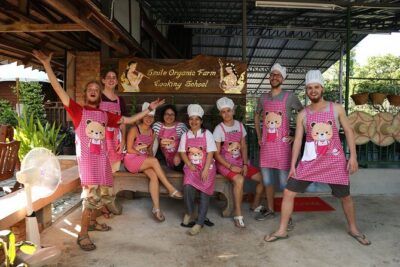
Half-Day Thai Cooking Class at Organic Farm in Chiang Mai
Read our review →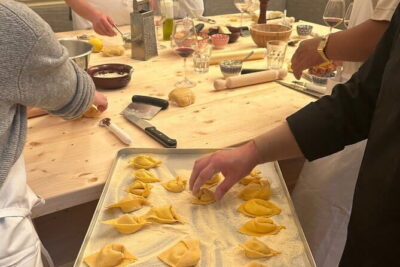
3 in 1 Cooking Class near Navona: Fettuccine, Ravioli & Tiramisu
Read our review →
Pasta & Tiramisu Cooking Class with Unlimited Wine
Read our review →
Hanoi Cooking Class: Culture, Local Market & Meaning CSR Impact
Read our review →
5 Traditional Dishes Hanoi Cooking Class with Market Trip
Read our review →
Cooking Class and Lunch at a Tuscan Farmhouse with Local Market Tour from Florence
Read our review →
Cooking Class, Market & Thai Herbs Garden Tour
Read our review →Lists this class appears in