
REVIEW · CHENGDU, CHINA
Half-day Chengdu Handmade Tofu Making and Mapo Tofu Cooking Class
Tofu begins with beans, not a supermarket block. This Chengdu workshop shows you the full process, from soaking soybeans and grinding them with a stone mill to making soy milk, tofu brain, pressed tofu, and Mapo Tofu. I like the visit to a local spice market, and I like the relaxed courtyard setting where tea, cooking, and conversation share equal billing. The main drawback is that the session can run from three to five hours, so you should not schedule it too tightly against another activity.
I also appreciate that the class teaches more than one dish. You learn how Sichuan seasonings work, then use them in a practical cooking session with a professional chef. The group limit of 15 keeps the class manageable, but a larger group may mean less individual attention at certain stages.
Key points before you book
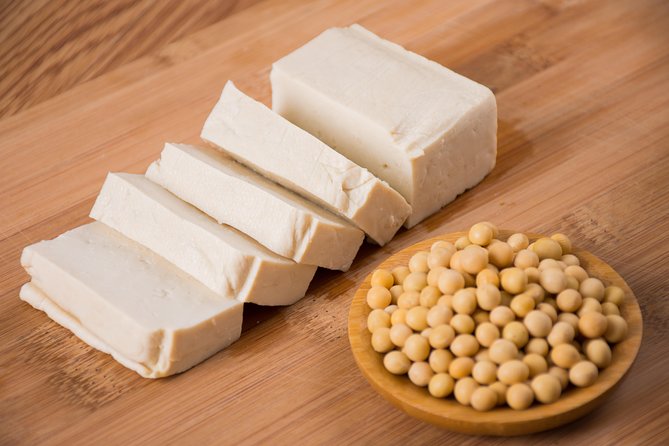
- Bean-to-tofu preparation: Use a stone mill and follow the old method of grinding, filtering, boiling, coagulating, and pressing soybeans.
- Chengdu spice market visit: Learn about Sichuan spices, produce, meats, and traditional Chinese medicine ingredients before cooking.
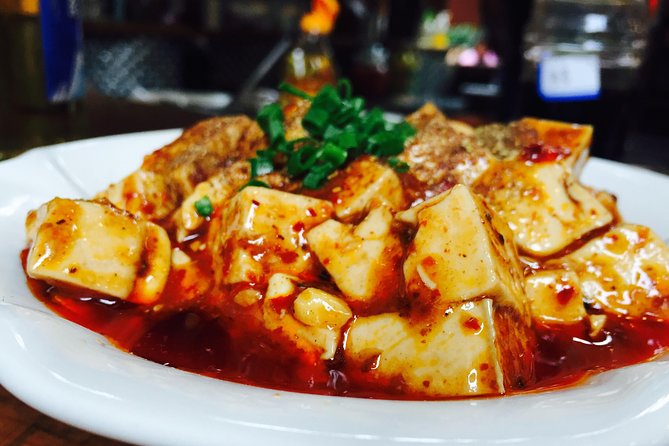
- Mapo Tofu instruction: Prepare Chengdu’s famous spicy tofu dish with guidance from a professional chef.
- Traditional courtyard setting: Drink local Sichuan tea in a courtyard kitchen rather than a formal cooking school.
- Small-to-medium group size: The class accepts a maximum of 15 people, with group discounts available.
- Practical extras included: Hotel pickup and drop-off, food tasting, tea, water, beer, and recipes are part of the experience.
Why tofu makes a smart Chengdu cooking class
Mapo Tofu is one of Chengdu’s signature dishes, but the finished bowl tells only part of the story. The tofu itself affects the texture, and the seasoning depends on the balance of Sichuan ingredients. This class gives you a chance to see both sides of the dish.
You begin with soybeans rather than prepared tofu. That means the class is partly a cooking lesson and partly a look at an older food-making tradition. You can see how soaked beans become a liquid pulp, how that pulp turns into soy milk, and how a coagulant changes it into tofu.
I like this approach because it gives you a better feel for the work behind an everyday food. It also makes the Mapo Tofu lesson more useful. You are not simply frying ingredients and copying a recipe. You are learning why tofu has the texture it does and how it reaches the wok.
The class is offered by Chilli Cool China, with a professional chef leading the kitchen portion. Lance and Jerry are associated with the workshops, and the atmosphere is described as warm, friendly, and well organized. Lance also leads the market portion, where his explanations cover fresh fruit, vegetables, meat, spices, and Chinese medicine ingredients.
More Half-Day Experiences in China:
- Half-Day Chengdu Cooking Class with a Local Market Visit
★ 5.0 · 465 reviews - Half-Day steamed Buns Cooking Class with a Local Market Visit
★ 5.0 · 26 reviews - Half-Day Professional Mapo Tofu Cooking with a Local Market Visit
★ 5.0 · 19 reviews
Start with Sichuan spices at the local market
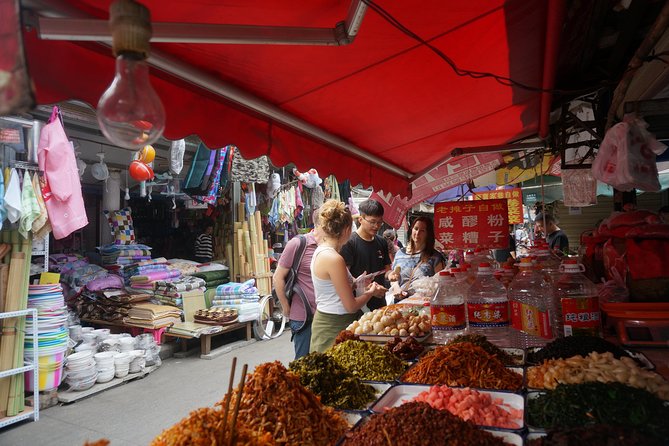
The first part takes you into a local spice market. This is a good move because Sichuan cooking depends on ingredients that can be hard to identify if you have not encountered them before.
The market visit is not just a quick walk past stalls. You are given fun challenges to help you identify different spices and ingredients used later in the class. That adds a game-like touch without taking away from the food lesson.
You can expect to look at the colors, shapes, and smells of Sichuan seasonings. The exact market route and individual ingredients are not specified, but the focus includes spices and common fresh foods used in local cooking. You may also see meat, produce, and traditional Chinese medicine items, all in the same market environment.
I especially like this part for first-time visitors to Chengdu. A cooking recipe tells you what to add, but a market visit helps you recognize the ingredients in daily life. You will also have a chance to ask questions before entering the kitchen, when the spices are still fresh in your mind.
There is one practical point to keep in mind. A market is an active local place, not a quiet classroom. If you prefer a tightly scripted tour with a fixed list of stops, this section may feel informal. If you enjoy learning by looking, asking, and handling unfamiliar ingredients, it should be one of the more useful parts of the morning.
Tea and tofu in a Sichuan courtyard
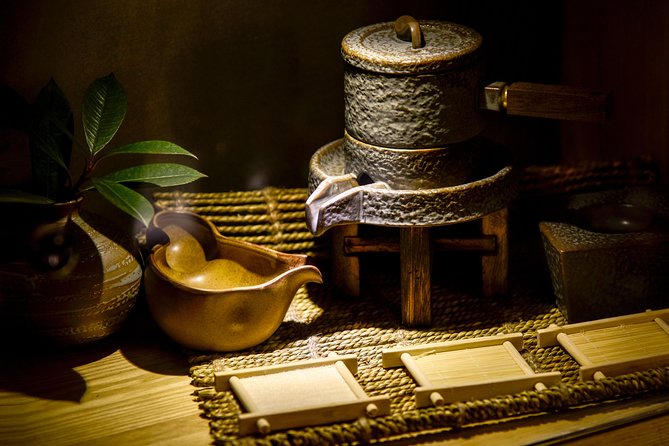
After the market, the class moves to a traditional Sichuan-style courtyard. You are served local tea, following the custom of offering tea to friends and visitors. This pause helps set the tone before the hands-on work begins.
The courtyard setting matters. It gives the class a sense of place that a generic cooking studio cannot easily provide. You are not only learning a recipe associated with Chengdu. You are also seeing how food preparation, tea, and hospitality fit together in a local setting.
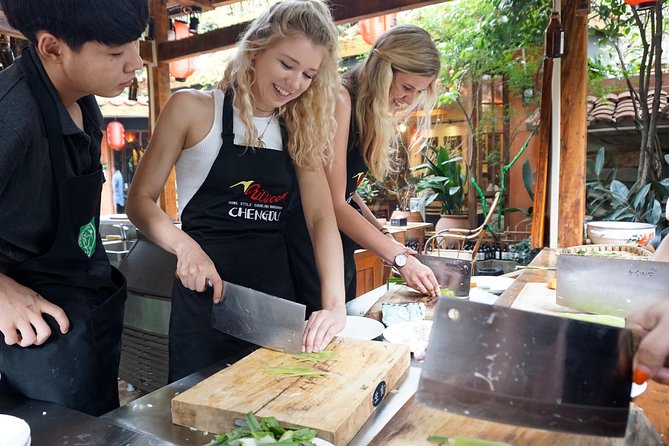
The class takes place in a cozy kitchen, with the chef guiding you through the process. Tea, water, and beer are included, and you finish by eating what you have made. Beer or another refreshing drink can make the final meal feel relaxed rather than rushed.
The setting sounds best suited to people who enjoy a social class. You may be working alongside up to 14 other people, so expect a shared activity rather than a private lesson. The maximum group size of 15 is reasonable, though the amount of one-on-one help can depend on the final number attending.
Grinding soybeans with a stone mill
The most distinctive part of the class is the tofu-making process. You start with soaked soybeans, then grind them into a pulp using a stone mill. This is slower and more physical than opening a carton of soy milk, which is precisely why it makes the lesson memorable.
The basic sequence includes:
- Soaking the soybeans
- Grinding them into pulp
- Filtering the pulp
- Boiling the liquid
- Adding bittern to make it coagulate
- Pressing the curds into shape
The class also shows how to make soy milk and tofu brain during the same process. Tofu brain is a soft, delicate form of fresh tofu, and it gives you a useful contrast with the firmer tofu later used for Mapo Tofu.
I like that the method is explained as a series of clear stages. You can see how each choice changes the result. Filtering separates the liquid from the solids. Boiling changes the bean mixture. Bittern causes the curds to form. Pressing determines the final shape and firmness.
This section may be more hands-on than some visitors expect. Making tofu takes time and attention, and it is not a quick demonstration followed by a tasting. If you want only a fast recipe lesson, the process may seem long. If you want to understand a traditional food from its starting point, it is the strongest reason to choose this class.
A few more cooking classes around China worth a look
- Online Cooking Class Beijing Dumplings and Cuisine by Sunflowerli Renowned Chef
★ 5.0 · 65 reviews - Chengdu: Cooking Class with Fresh Market Half Day Experience
★ 5.0 · 42 reviews - Shanghai-Cooking Dumpling & Meal in Local Family-w/Vegan
★ 4.9 · 36 reviews - Private Cooking Class: Make Your Own Dim Sum In Shanghai
★ 5.0 · 27 reviews
Cooking Mapo Tofu with a professional chef
Once you have explored the tofu process, the class turns to Mapo Tofu. The chef teaches you how to prepare the dish using the Sichuan ingredients introduced at the market.
Mapo Tofu is famous for its soft tofu, spicy sauce, and distinctive Sichuan seasoning. The class gives you a chance to connect the ingredients on the market shelves with the dish in front of you. That connection is more helpful than receiving a recipe without context.
The available information does not specify every ingredient or the exact sequence of the cooking demonstration, so you should not expect a fully published menu before arrival. What is clear is that Mapo Tofu is central to the class, and that the chef guides you through preparing it.
You will also receive recipes, which adds value after the class ends. A recipe is particularly useful here because tofu texture and Sichuan seasoning may be unfamiliar if you usually cook with Western pantry ingredients. You can refer back to the written instructions instead of relying on memory after a busy morning.
The finished meal includes food tasting, and you can enjoy it with tea, water, beer, or another refreshing drink. This is a satisfying end to a hands-on class because you eat the results rather than simply watching the chef cook.
What the market and kitchen teach together
The class works best when you treat the market and kitchen as two halves of the same lesson. At the market, you see the raw ingredients and begin to understand their role. In the courtyard kitchen, you turn those ingredients into tofu and Mapo Tofu.
That structure also gives the class a stronger sense of Chengdu than a standard cooking demonstration. You are learning about food preparation, but you are also seeing how local ingredients are bought, discussed, and used.
The tofu work offers a lesson in patience. The Mapo Tofu offers a lesson in balance. The market offers a lesson in recognition. Together, they make a fuller introduction to Sichuan food than a single restaurant meal can provide.
The workshop has also earned praise for its relaxed atmosphere and organization. One person enjoyed the morning class enough to continue into an afternoon workshop focused on steamed pork buns. That second class is not part of this half-day booking, but it suggests that the teaching style can appeal to people who want a social, hands-on activity rather than a formal lecture.
Timing, meeting point, and transport
The advertised duration is about three to five hours, with the main class described as roughly four hours. Allow the full five hours when planning your day. The market visit, tea, tofu preparation, cooking, tasting, and transport can all affect the final timing.
The listed meeting point is on the North Third Section of the First Ring Road, at Yi Huan Lu Bei San Duan, in Jinniu District, Chengdu. The activity ends back at the meeting point.
Hotel pickup and drop-off are included, which can simplify the morning. At the same time, you should confirm the pickup arrangement and timing when booking, since the published information also gives a fixed meeting point. The location is near public transportation, so you have another option if you do not use the hotel service.
Confirmation is provided at booking. The activity can accept a maximum of 15 people, and group discounts are available. Children must be accompanied by an adult, and the activity is described as suitable for most people.
The tour requires good weather. If poor weather causes a cancellation, you are offered another date or a full refund. You can also cancel for a full refund up to 24 hours before the start time. Changes or cancellations inside that 24-hour window are not accepted.
Is the $90 price good value?
At $90 per person, this is not the cheapest cooking activity in Chengdu. The value depends on what you want from the morning.
You are paying for more than one recipe. The price includes the local market visit, a professional guide and chef, the complete tofu-making process, Mapo Tofu instruction, food tasting, recipes, tea, water, beer, and hotel pickup and drop-off. You also receive a mobile ticket, and group discounts may reduce the cost for larger parties.
The stone-mill tofu work is the feature that helps justify the price. Many cooking classes focus on preparing a few dishes from ready-to-use ingredients. Here, you follow soybeans through several changes before reaching the finished food.
The price makes more sense if you value local context and active participation. If you only want to eat Mapo Tofu, a restaurant will cost less and take less time. If you want a food lesson that connects the market, traditional preparation, and finished dish, $90 is a reasonable rate for a half-day activity.
Who should book this class?
I would recommend it to anyone who enjoys food with a process behind it. It is a strong choice for visitors who want to learn about Sichuan cooking beyond ordering spicy dishes in restaurants.
It should also suit families with older children, since children are allowed when accompanied by an adult. The group format may work well for friends, couples, and solo visitors who like meeting people through a shared activity.
You may want to skip it if you dislike hands-on preparation, prefer a short class, or have a tightly packed schedule. The tofu-making stages require time, and the total visit can reach five hours.
It is also not the right choice if you want a private cooking lesson. The group can reach 15 people, so the experience is social rather than exclusive. Still, the friendly approach, tea service, and final meal should make it comfortable for most people who enjoy casual instruction.
Should you book the Chengdu tofu workshop?
Book this class if you want to understand how tofu is made and how Sichuan ingredients become Mapo Tofu. The best parts are the stone-mill process, the local market visit, and the chance to sit down and eat what you prepared.
The main trade-off is time. You need half a day and some patience, and a group of 15 may limit personal attention. For a practical introduction to Chengdu food traditions, though, the combination of market, courtyard, tofu, tea, and Mapo Tofu gives you good value for the price.
FAQ
How long does the Chengdu tofu and Mapo Tofu class last?
The experience lasts approximately three to five hours. The main workshop is described as about four hours.
How much does the experience cost?
The listed price is $90 per person. Group discounts are available.
Where does the activity start?
The listed meeting point is at 1st Ring Road North 3 Section, Yi Huan Lu Bei San Duan, Jinniu District, Chengdu, China, 610051.
Does the tour include hotel pickup and drop-off?
Yes. Hotel pickup and drop-off are included.
What food will I learn to prepare?
You learn to make handmade tofu from soybeans, soy milk, tofu brain, and Mapo Tofu.
Is the class suitable for children?
Children can participate, but they must be accompanied by an adult.
How many people can join the class?
The activity accepts a maximum of 15 people.
Can I cancel for a refund?
Yes. You can cancel at least 24 hours before the start time for a full refund. Cancellations or changes made less than 24 hours before the start time are not accepted.
Just added around China
- Private Panda Tour with Cooking Class One-day Trip★ 5.0 · 11 reviews
- Half-day Dandan Noodles Cooking Class with a Local Market Visit★ 5.0 · 8 reviews
- Half-Day Private Hot-Pot Cooking Class with a Local Market Visit★ 5.0 · 3 reviews
- Chengdu Dujiangyan Leshan Buddha Tea Plantation and Sichuan Cooking 3 Days★ 5.0 · 2 reviews
- Half day Chengdu Dumpling Class: Make from Scratch★ 5.0 · 8 reviews
- Half-Day Sichuan Cooking Class Experience in Chengdu★ 4.0 · 17 reviews
- Beijing: Private Dumpling Cooking Class in Local Family★ 5.0 · 3 reviews
- Dumpling Cooking Class and Local Market Tour★ 5.0 · 3 reviews
Cooking Classes, compared.

Half-Day Thai Cooking Class at Organic Farm in Chiang Mai
Read our review →

3 in 1 Cooking Class near Navona: Fettuccine, Ravioli & Tiramisu
Read our review →
Pasta & Tiramisu Cooking Class with Unlimited Wine
Read our review →
Hanoi Cooking Class: Culture, Local Market & Meaning CSR Impact
Read our review →
5 Traditional Dishes Hanoi Cooking Class with Market Trip
Read our review →
Cooking Class and Lunch at a Tuscan Farmhouse with Local Market Tour from Florence
Read our review →
Cooking Class, Market & Thai Herbs Garden Tour
Read our review →Lists this class appears in