
REVIEW · UPPER AUSTRIA, AUSTRIA
Cookies and Apple Strudel Cooking Class Including Lunch
Salzburg tastes better warm from the oven. This 90-minute class gives you a hands-on way to meet Austrian food, not just order it in a café. I like the small-group setup, with no more than 15 people, and I like that the lunch is part of the experience rather than an extra charge. The only drawback is that the schedule can feel a little brisk if you want long, leisurely time at each step.
You make an apple strudel from start to finish, then shape vanilla kipferl, one of Salzburg’s best-known cookies. While everything bakes, you eat goulash soup and chat with people from several countries. The unusual rock-built kitchen adds character, though the food itself is the main reason to book.
Key points at a glance
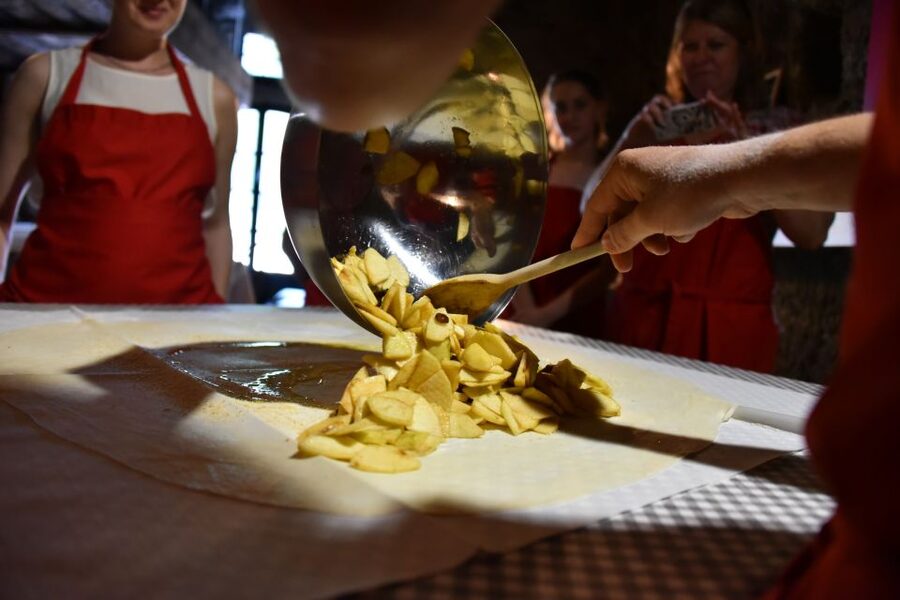
- Make your own apple strudel: You marinate the apples, work with the pastry, stretch it out, fill it, and taste the finished dessert.
- Bake Salzburg-style vanilla kipferl: These crescent-shaped cookies are a popular local treat and give you a second hands-on task.
- Lunch is included: Goulash soup arrives while your baking is in the oven. Drinks cost extra.
- Small tables keep the class personal: The maximum group size is 15, with people working in tables of two to four.
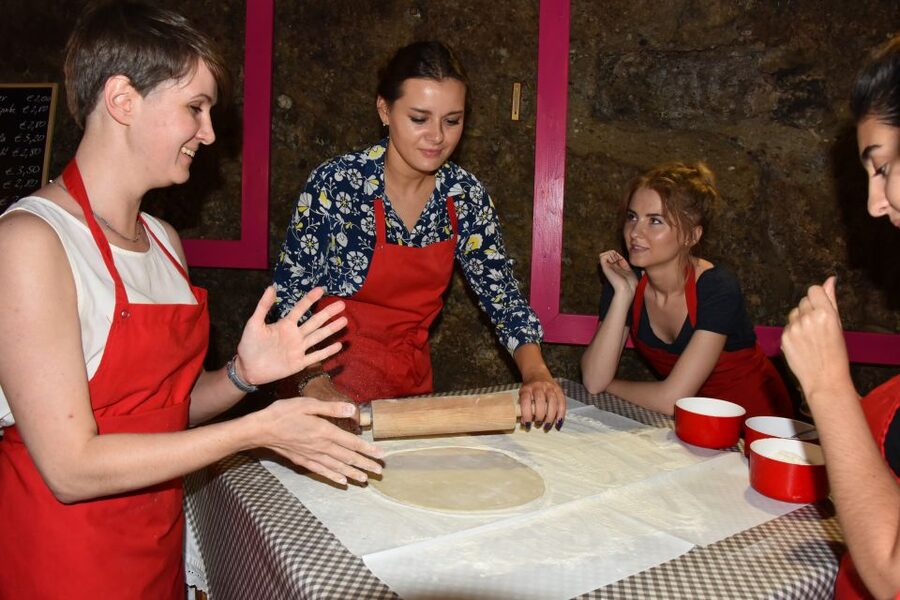
- A memorable setting: The cooking school is in a cozy space built into the rock or cliff wall near Salzburg’s old town.
- Easy to fit into a sightseeing day: The meeting point at Ursulinenplatz 9 is about a 10-minute walk from Mirabell Square or Mozart Square.
Why this Salzburg cooking class works so well
A cooking class can be a great break from museums, churches, and city walks. This one is especially practical because you eat lunch during the class, then finish with two Austrian desserts you helped prepare.
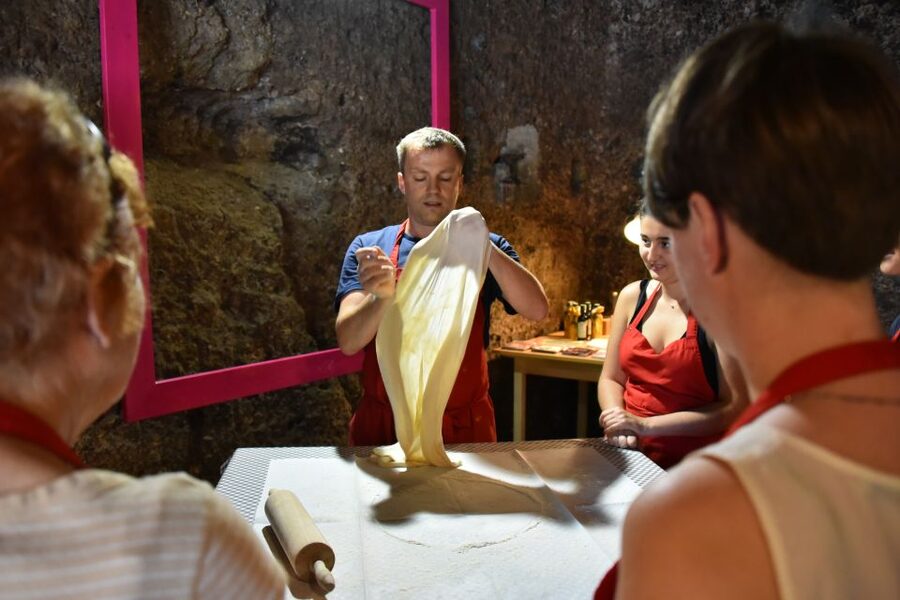
I like the balance between instruction and participation. You are not simply watching a chef demonstrate a recipe while standing at the back of a crowded room. The instructor shows you what to do, then you take over at your table. That makes the class useful for beginners and entertaining for people who already know their way around a kitchen.
The group limit matters. Fifteen people is still enough for a social atmosphere, but small tables of two to four let you work with your hands without fighting for space. Some sessions have been much smaller, with only six people, which gives the instructor more time to help each pair.
The atmosphere is relaxed rather than formal. Instructors named in class feedback include Ishmael, Alina, Agnes, Johann, and Simone, and the strongest pattern is clear: the teaching is friendly, organized, and easy to follow. You can expect help when you need it, without being treated as if you are taking a professional exam.
More Lunch Trips in the world:
- Cooking Class and Lunch at a Tuscan Farmhouse with Local Market Tour from Florence
★ 5.0 · 4,831 reviews - Paris Cooking Class and Lunch with Wine plus Market Visit Option
★ 5.0 · 1,024 reviews - Austrian Apple Strudel Cooking Class including Lunch in Salzburg
★ 5.0 · 929 reviews
Finding the school near Mirabell and Mozart Square
The meeting point is Ursulinenplatz 9, 5020 Salzburg, roughly a 10-minute walk from either Mirabell Square or Mozart Square. That makes the class easy to add to a day in central Salzburg without arranging a separate ride.
The setting gives the experience some extra charm. The cooking room is described as being built into a rock or cliff wall, creating a warm, unusual atmosphere. It is not just another bright, modern classroom. The stone surroundings, baking smells, and compact kitchen help the class feel connected to Salzburg rather than interchangeable with a cooking lesson anywhere else.
I would allow a little extra time to find the exact entrance, especially if you are coming straight from a tour or moving through the old town with luggage. The official meeting point is clear, but arriving early is still sensible for a timed class.
The activity is offered in English, and the instructors give their directions in English. The school is wheelchair accessible, which is useful to know when planning a mixed-mobility day.
Stretching pastry for your first apple strudel
The class begins with apple strudel, the main event. You take part in each stage, including preparing and marinating the apples and stretching the pastry.
That pastry step is where the class becomes more than a standard baking demonstration. Strudel dough needs to become thin without tearing, and the process gives you a feel for the care behind a dessert that can look deceptively simple on a café plate. You may find the stretching part the most challenging step, but it is also the part you are most likely to remember.
The goal is not perfection. The instructors guide the process and step in when help is needed. The class is designed so that beginners can participate fully, including children. A family with children aged five and eight found that both could take part, while another family with children aged 10 and 12 enjoyed the class from start to finish.
Once the apples and pastry are ready, you assemble your own strudel and put it in the oven. The reward comes later, when you eat the dessert warm. Some participants have also been able to take leftover strudel and cookies home, though you should not count on having a large amount left over.
Making vanilla kipferl while the strudel bakes
The second baking project is vanilla kipferl, a popular Salzburg cookie. These are shaped by hand, so the activity changes pace while the strudel cooks.
This is a good addition to the class. You are not left waiting around for the oven, and you get to compare two very different kinds of Austrian baking. The strudel involves pastry stretching and filling, while the cookies are smaller, more tactile, and easy to shape at your table.
The cookie-making also suits children and mixed-age groups. You can get involved without needing advanced technique, and the relaxed format leaves room for conversation. One especially nice touch is the chance to sample a little cookie dough during the process, as long as the instructor offers it that day.
The cookies are served with the rest of your meal after baking. They may also make a good take-home treat if you have leftovers, but the amount depends on what you prepare and eat in class.
A few more cooking classes around the world worth a look
- Half-Day Thai Cooking Class at Organic Farm in Chiang Mai
★ 5.0 · 19,087 reviews - Florence: Pasta Cooking Class with Unlimited Wine
★ 4.9 · 10,285 reviews - 3 in 1 Cooking Class near Navona: Fettuccine, Ravioli & Tiramisu
★ 5.0 · 7,376 reviews - Florence: Pasta & Tiramisu Cooking Class with Unlimited Wine
★ 4.9 · 6,708 reviews
Goulash soup turns the baking time into lunch
While the desserts are in the oven, you sit down to goulash soup. It is included in the $70 price, and it gives the class a proper middle section rather than making you wait hungry for dessert.
The soup is repeatedly praised as a highlight, especially on cold days. Several people found it satisfying, and one family rated it among the best goulash they had eaten. That praise matters because lunch is not just a small snack added to the booking. It is the savory part of the meal, followed by your warm strudel and cookies.
Drinks are not included. Beer, wine, and schnapps are available at reasonable prices according to the available class details, but you should budget separately if you want one. Water and other drink arrangements are not specified, so check on arrival if you have a particular preference.
This lunch break is also when the social side of the class really works. You share a table, compare baking efforts, and meet people from different countries. Solo visitors can join the conversation easily, while couples and families have enough structure to stay together.
How the 90-minute schedule feels
Ninety minutes is a compact format. It works well if you want a food activity without giving up half a day of sightseeing, but you should not expect a slow, restaurant-style afternoon.
The likely rhythm is straightforward:
- You receive instructions and begin the apple strudel.
- You prepare the apples and work with the pastry.
- Your strudel goes into the oven.
- You make vanilla kipferl.
- You eat goulash soup during the baking time.
- You taste the finished strudel and cookies.
The preparation is planned to keep you occupied, so the class does not drag. At the same time, one person found the experience slightly rushed. That is the main consideration for anyone who wants detailed culinary training or lots of time for questions.
For most people, the pace is a fair trade. You get a complete cooking experience, lunch, and dessert in a short block that fits before an afternoon activity or after a morning tour. If you want a professional pastry lesson with repeated practice, choose a longer course. If you want a fun introduction to Austrian baking, 90 minutes is enough.
What makes the food feel Austrian
Strudel and kipferl are not random baking choices. They connect the class to the sweets you will see in Austrian cafés and bakeries.
Apple strudel is especially useful as a cultural introduction because its ingredients are familiar, but its preparation has a local identity. The apples, filling, pastry, and warm serving style come together in a dessert that feels tied to Central European café culture.
Vanilla kipferl adds another piece of the picture. The cookies are strongly associated with Austrian baking and are especially common around Christmas. If you visit Salzburg in November or December, making them fits the season beautifully, though the class is also suitable at other times of year.
The instructor also shares information about Austrian cuisine and its background. The amount of culinary history may vary by class, but the activity gives you useful context through the food itself. You learn why the pastry needs care, how the cookies are formed, and how both fit into everyday Austrian eating.
Is $70 a fair price?
At $70 per person, the class is not the cheapest lunch in Salzburg. You could buy soup and dessert for less. But the price includes instruction, ingredients, hands-on preparation, your cooked strudel, the cookies, and goulash soup.
That makes the value better if you already planned to eat lunch and want an activity as well. You are paying for an experience, not just a plate of food. The class also gives you a chance to meet other people, learn recipes, and possibly take some baking home.
I think the price works best for couples, families, and solo visitors who want a social food experience. It is less compelling if your main goal is simply an inexpensive meal or if you dislike group activities.
The reserve-now, pay-later option keeps your plans flexible, and free cancellation is available up to 24 hours before the activity for a full refund. Starting times vary, so check availability when choosing a date.
Who should book this class
I would recommend it most strongly to:
- First-time visitors to Salzburg who want a local food experience between major sights.
- Families with children who need an activity where everyone can participate.
- Couples looking for something more memorable than another café stop.
- Solo visitors who enjoy meeting people at a shared table.
- Baking beginners who want clear guidance without a formal or intimidating setting.
- Cold-weather visitors who will appreciate hot soup, warm pastry, and a cozy rock-built kitchen.
The class may be less suitable if you need a quiet meal, dislike working in a group, or want advanced instruction. It is social and practical, not a private chef lesson.
Smart planning tips before you go
Book this as a lunch activity, not as a separate dessert stop. The goulash soup is substantial enough to make the timing work, and your strudel and cookies follow as the sweet course.
Wear something comfortable for standing and hands-on preparation. Specific clothing rules are not provided, but baking can be messy, and you will be working directly with pastry, apples, and dough.
Give yourself time to walk to Ursulinenplatz 9. The location is close to central Salzburg, but a 10-minute walk can take longer if you are navigating unfamiliar streets or arriving from a morning tour.
If you are visiting with children, explain that they will be involved in the preparation rather than simply watching. That is one of the class’s strengths. Children can shape cookies and participate in the same general process as adults.
If you want a drink with lunch, bring extra money. Drinks are not included, though beer, wine, and schnapps may be available to purchase.
Final verdict: book it for food, fun, and a manageable schedule
I would book this class if you want an approachable taste of Austrian culture that fits neatly into a Salzburg sightseeing day. The strongest features are the hands-on strudel making, the friendly instruction, the included goulash lunch, and the unusual stone-built setting.
The $70 price is fair when you treat it as both lunch and an activity. Just keep your expectations in line with the 90-minute schedule. You will learn useful techniques and make tasty food, but you may not have time for a long pastry lecture or repeated attempts.
For families, couples, solo visitors, and anyone who enjoys eating what they make, this is an easy recommendation. If you prefer private dining or advanced baking instruction, spend your time and money elsewhere.
FAQ
Where does the apple strudel and cookie cooking class meet?
The meeting point is Ursulinenplatz 9, 5020 Salzburg. It is about a 10-minute walk from Mirabell Square or Mozart Square.
How long does the cooking class last?
The class lasts 90 minutes. Starting times vary, so you need to check availability for your chosen date.
How much does the experience cost?
The listed price is $70 per person. Taxes, fees, handling charges, and lunch are included.
Is lunch included?
Yes. Goulash soup is included and is served while the apple strudel and cookies are baking.
Are drinks included?
No. Drinks are not included in the price. Beer, wine, and schnapps may be available to buy separately.
What will I make during the class?
You will prepare an Austrian apple strudel and vanilla kipferl cookies. You take part in the preparation and taste the cooked results.
How large is the cooking class?
Each class has a maximum of 15 people. Participants work at tables with two to four people.
Is the class taught in English?
Yes. The instructor teaches in English, and English is the listed language for the activity.
Can I cancel the booking?
You can cancel up to 24 hours in advance for a full refund. The activity also offers a reserve-now, pay-later option.
Just added around the world
- Aroidee’s Farm-Fresh Thai Cooking Experience★ 5.0 · 8 reviews
- Signature Thai Cooking Course★ 5.0 · 79 reviews
- Private Half-Day Thai Cooking Class in Chiang Mai★ 5.0 · 4 reviews
- Half Day Guided Thai Cooking Class in Chiang Mai★ 5.0 · 13 reviews
- Online Thai and Akha Cooking Class★ 5.0 · 70 reviews
- Private Virtual Thai Cooking Class★ 5.0 · 9 reviews
- Northern Thai Cooking Class in Chiang Mai in a Countryside Home★ 5.0 · 2 reviews
- 5 Hour Morning Thai Cooking Course★ 5.0 · 31 reviews
Cooking Classes, compared.

Half-Day Thai Cooking Class at Organic Farm in Chiang Mai
Read our review →

3 in 1 Cooking Class near Navona: Fettuccine, Ravioli & Tiramisu
Read our review →
Pasta & Tiramisu Cooking Class with Unlimited Wine
Read our review →
Hanoi Cooking Class: Culture, Local Market & Meaning CSR Impact
Read our review →
5 Traditional Dishes Hanoi Cooking Class with Market Trip
Read our review →
Cooking Class and Lunch at a Tuscan Farmhouse with Local Market Tour from Florence
Read our review →
Cooking Class, Market & Thai Herbs Garden Tour
Read our review →Lists this class appears in